>
Anguilliformes (Eels and morays) >
Heterenchelyidae (Mud eels)
Etymology: Pythonichthys: Greek, python = the huge serpent or monster slain near Delphi by Apollo in the Greek mithology (1590) Greek, ichthys = fish (Ref. 45335).
More on author: Poey.
Ambiente: milieu / zona climatica / distribuzione batimetrica / gamma di distribuzione
Ecologia
marino associati a barriera corallina; distribuzione batimetrica ? - 37 m (Ref. 13608). Tropical
Western Central Atlantic: off Cuba, Puerto Rico, and Suriname.
Dimensione / Peso / Età
Maturità: Lm ? range ? - ? cm
Max length : 41.9 cm TL maschio/sesso non determinato; (Ref. 13608)
Breve descrizione
Chiavi di identificazione | Morfologia | Morfometria
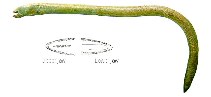
Body nearly cylindrical; anus situated forward of mid-body; eye extremely small, embedded, merely a tiny dot, equidistant between tip of snout and corner of mouth; anterior nostril near tip of snout, posterior nostril immediately in front of eye (Ref. 13608).
Body shape (shape guide): eel-like.
A benthic species found on reefs or rocky areas (Ref. 26340).
Ciclo vitale e comportamento di accoppiamento
Maturità | Riproduzione | Deposizione | Uova | Fecondità | Larve
Uyeno, T., K. Matsuura and E. Fujii (eds.), 1983. Fishes trawled off Suriname and French Guiana. Japan Marine Fishery Resource Research Center, Tokyo, Japan. 519 p. (Ref. 13608)
Stato della Lista Rossa IUCN (Ref. 130435: Version 2025-2 (Global))
Minaccia per l'uomo
Harmless
Usi umani
Strumenti
Rapporti speciali
Scarica XML
Fonti Internet
Stime basate su modelli
Indice di diversità filogenetica (Fonte Biblio.
82804): PD
50 = 0.5664 [Uniqueness, from 0.5 = low to 2.0 = high].
Bayesian length-weight: a=0.00102 (0.00046 - 0.00225), b=3.06 (2.88 - 3.24), in cm total length, based on all LWR estimates for this body shape (Ref.
93245).
Livello trofico (Fonte Biblio.
69278): 3.7 ±0.6 se; based on size and trophs of closest relatives
Vulnerabilità della pesca (Ref.
59153): Low to moderate vulnerability (32 of 100).
🛈