>
Lophiiformes (Anglerfishes) >
Linophrynidae (Leftvents)
Etymology: Linophryne: Greek, 'linon' = flax or anything made of flax such as "cord," "rope," or a "net" + Greek, 'phryne' = "toad" (refers to a toadlike fish that fishes with a net) (Ref. 86949).
Eponymy: The fallen angel Lucifer, of the Judeo-Christian tradition, is referred to in the fourteenth chapter of the Biblical book of Isaiah: ‘How art thou fallen from heaven, O Lucifer, son of the morning! How art thou cut down to the ground, which didst we [...] (Ref. 128868), visit book page.
Umwelt: Milieu / Klimazone / Tiefenbereich / Verbreitungsgebiet
Ökologie
seewasser bathypelagisch; tiefenbereich 0 - 1000 m (Ref. 5951), usually 300 - 600 m (Ref. 86949). Deep-water
North Atlantic, from off Iceland, and East and West Greenland; extending farther south from off Newfoundland to Madeira.
Größe / Gewicht / Alter
Geschlechtsreife: Lm ? range ? - ? cm
Max length : 2.9 cm SL Männchen/unbestimmt; (Ref. 86949); 27.5 cm SL (female)
Kurzbeschreibung
Bestimmungsschlüssel | Morphologie | Morphometrie
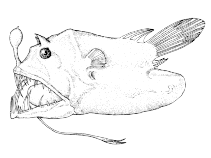
Rückenflossenweichstrahlen (insgesamt) : 3; Afterflossenweichstrahlen: 2 - 3. Metamorphosed females distinguished by the following characteristics: escal bulb with conical distal prolongation bearing short, stout filaments; posterior escal appendage small and conical; absence of additional escal appendages; barbel with single stem, divided distally into a pair of compressed pointed branches, each bearing a series of photophores on one edge and with a pair of short, simple lateral branches on distal half of stem, each with few photophores at distal tip; parasitic males with pointed sphenotic spines (Ref. 86949).
Caught in high latitudes by commercial bottom trawls at about 300-600 m, with open pelagic trawls fished at maximum depth of 1000 m (Ref. 86949).
Lebenszyklus und Paarungsverhalten
Geschlechtsreife | Fortpflanzung | Ablaichen | Eier | Fruchtbarkeit | Larven
Bertelsen, E., 1986. Linophrynidae. p. 1408-1414. In P.J.P. Whitehead, M.-L. Bauchot, J.C. Hureau, J. Nielsen, and E. Tortonese (eds.) Fishes of the North-eastern Atlantic and the Mediterranean. UNESCO, Paris, Vol. 3. (Ref. 13578)
IUCN Rote Liste Status (Ref. 130435: Version 2025-2 (Global))
Bedrohung für Menschen
Harmless
Nutzung durch Menschen
Fischereien: bycatch
Tools
Zusatzinformationen
Download XML
Internet Quellen
Schätzungen auf der Grundlage von Modellen
Phylogenetischer Diversitätsindex (Ref.
82804): PD
50 = 0.5000 [Uniqueness, from 0.5 = low to 2.0 = high].
Bayesian length-weight: a=0.01000 (0.00244 - 0.04107), b=3.04 (2.81 - 3.27), in cm total length, based on all LWR estimates for this body shape (Ref.
93245).
Trophische Ebene (Ref.
69278): 4.2 ±0.5 se; based on size and trophs of closest relatives
Anfälligkeit der Fischerei (Ref.
59153): Low vulnerability (24 of 100).
🛈