>
Cypriniformes (Carps) >
Leuciscidae (Minnows) > Leuciscinae
Etymology: Notemigonus: Greek, noton = back + Greek, gonia = angled (Ref. 45335); crysoleucas: notemigonus, angled back; cryso, meaning gold; and leucas, white (Ref. 10294).
More on author: Mitchill.
Milieu: milieu / Klimaatzone / Diepte / verspreidingsgebied
Ecologie
; zoet water; brak water demersaal; diepte 10 - ? m. Subtropical; 0°C - 35°C (Ref. 35682); 52°N - 25°N
North America: Atlantic and Gulf Slope drainages from Nova Scotia in Canada to southern Texas, USA; Great Lakes, Hudson Bay (Red River), and Mississippi River basins west to Saskatchewan in Canada, and Montana, west Oklahoma and Texas in USA.
Lengte bij maturiteit / Grootte / Gewicht / Leeftijd
Maturiteit: Lm 6.4 range ? - ? cm
Max length : 32.0 cm TL mannelijk / geslacht onbekend; (Ref. 86798); common length : 14.4 cm TL mannelijk / geslacht onbekend; (Ref. 12193); max. gerapporteerde leeftijd: 9 Jaren (Ref. 72462)
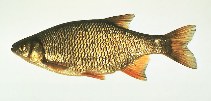
Dorsale zachte stralen (totaal) : 7 - 9; Anale zachte stralen: 8 - 19. Body extremely compressed; lateral line strongly decurved; scaleless keel along belly from pelvic to anal fin; dorsal- fin origin behind pelvic-fin origin; mouth small, upturned on pointed snout; appears silver in clear and turbid water, and gold side and fins in coffee-colored water; fins red in southern hemisphere; dusky stripe along side, herringbone lines on upper side of young. Scales on lateral line 44-54; dorsal fin with 7-9 rays; anal fin with 8-19 rays, usually 11-14; rakers on 1st gill arch 17-19; and pharyngeal teeth 0,5-5,0 (Ref. 86798).
Body shape (shape guide): fusiform / normal.
Adults inhabis vegetated lakes, ponds, swamps, backwaters and pools of creeks and small to medium rivers (Ref. 86798). Can tolerate low oxygen levels, high turbidity and high temperature; omnivorous but principally feed on plankton, insects and mollusks (Ref. 27549). Migratory behaviour is undetermined (Ref. 126106).
Page, L.M. and B.M. Burr, 2011. A field guide to freshwater fishes of North America north of Mexico. Boston : Houghton Mifflin Harcourt, 663p. (Ref. 86798)
Status op de Rode Lijst van het IUCN (Ref. 130435: Version 2025-2 (Global))
Gevaar voor de mens
Harmless
Gebruik door de mens
Visserij: van minder commercieel belang; Aquacultuur: commercieel; Aquarium: Publieke aquaria; aas: usually
Tools
Speciale rapporten
Download XML
Internetbronnen
Schattingen op basis van modellen
Fylogenetische diversiteitsindex (Ref.
82804): PD
50 = 1.0000 [Uniqueness, from 0.5 = low to 2.0 = high].
Bayesian length-weight: a=0.01023 (0.00680 - 0.01539), b=3.07 (2.95 - 3.19), in cm total length, based on LWR estimates for this species & (Sub)family-body (Ref.
93245).
Trofisch niveau (Ref.
69278): 2.7 ±0.1 se; based on diet studies.
Weerstandsvermogen (Ref.
120179): Gemiddeld, minimale populatieverdubbelingstijd 1,4-4,4 jaar (tm=2; tmax=9; Fec=200,000).
Kwetsbaarheid van de visserij (Ref.
59153): Low vulnerability (22 of 100).
🛈