>
Blenniiformes (Blennies) >
Blenniidae (Combtooth blennies) > Blenniinae
Etymology: Parenchelyurus: Greek, Greek, para in the side of + Greek, enchelys, -yos = eel + Greek, oura = tail (Ref. 45335).
More on author: Whitley.
Entorno: milieu / zona climática / rango de profundidad / gama de distribución
Ecología
marino bentopelágico. Tropical
Western Pacific: Papua New Guinea.
Tamaño / Peso / Edad
Madurez: Lm ? range ? - ? cm
Max length : 3.8 cm TL macho / no sexado; (Ref. 90102)
Descripción breve
Claves de identificación | Morfología | Morfometría
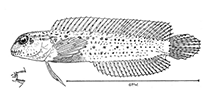
Espinas dorsales (total) : 10 - 11; Radios blandos dorsales (total) : 16 - 17; Espinas anales: 2; Radios blandos anales: 20 - 21. Color in life unknown. No notch between spinous and soft portions; segmented caudal rays 13; lacking lateral-line tubes; gill opening extending ventrally opposite 1st to 4th pectoral ray; lacking head cirri and crest; body depth about 4.7 in SL (Ref. 90102).
Body shape (shape guide): elongated; Cross section: oval.
Adults are found beneath rocks at shallow depths (Ref. 90102). Oviparous. Eggs are demersal and adhesive (Ref. 205), and are attached to the substrate via a filamentous, adhesive pad or pedestal (Ref. 94114). Larvae are planktonic, often found in shallow, coastal waters (Ref. 94114).
Ciclo vital y comportamiento de apareamiento
Madurez | Reproducción | Puesta | Huevos | Fecundidad | Larva
Oviparous, distinct pairing (Ref. 205).
Kailola, P.J., 1987. The fishes of Papua New Guinea: a revised and annotated checklist. Vol. II Scorpaenidae to Callionymidae. Research Bulletin No. 41, Research Section, Dept. of Fisheries and Marine Resources, Papua New Guinea. (Ref. 6192)
Situación en la Lista Roja de la UICN (Ref. 130435: Version 2025-2 (Global))
Amenaza para el ser humano
Harmless
Usos humanos
Herramientas
Informes especiales
Descargar XML
Fuentes de Internet
Estimaciones basadas en modelos
Índice de diversidad filogenética (Referencia
82804): PD
50 = 0.7500 [Uniqueness, from 0.5 = low to 2.0 = high].
Bayesian length-weight: a=0.00575 (0.00255 - 0.01297), b=3.06 (2.87 - 3.25), in cm total length, based on LWR estimates for this (Sub)family-body shape (Ref.
93245).
Nivel trófico (Referencia
69278): 3.2 ±0.4 se; based on size and trophs of closest relatives
Resiliencia (Referencia
120179): Alto, población duplicada en un tiempo mínimo inferior a 15 meses (Preliminary K or Fecundity.).
Vulnerabilidad pesquera (Ref.
59153): Low vulnerability (10 of 100).
🛈