Environnement : milieu / zone climatique / profondeur / gamme de distribution
Écologie
marin bathypélagique; profondeur 300 - 2626 m (Ref. 44036). Deep-water
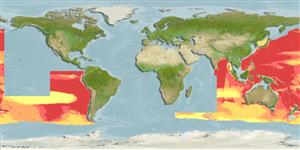
Indo-West Pacific: Bay of Bengal (Ref. 26282), Solomon Sea (Ref. 6993), New Zealand (Ref. 5755), and Japan (Ref. 35851). Southeast Pacific: Chile (Ref. 9068). South China Sea (Ref.74511)
Taille / Poids / Âge
Maturité: Lm ? range ? - ? cm
Max length : 4.2 cm SL mâle / non sexé; (Ref. 44036)
Description synthétique
Clés d'identification | Morphologie | Morphométrie
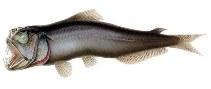
Rayons mous dorsaux (Total) : 12; Rayons mous anaux: 27; Vertèbres: 46. Body moderately elongate, deep strongly compressed. Body and head naked. Skin smooth, delicate and easily torn. Head and body dark brown with brassy green iridescence in alcohol (Ref. 35851).
Body shape (shape guide): elongated.
Cycle de vie et comportement reproducteur
Maturité | Reproduction | Frai | Œufs | Fécondité | Larves
Kailola, P.J., 1987. The fishes of Papua New Guinea. A revised and annotated checklist. Vol. 1. Myxinidae to Synbranchidae. Research Bulletin No. 41. Department of Fisheries and Marine Resources, Port Moresby, Papua New Guinea. 194 p. (Ref. 6993)
Statut dans la liste rouge de l'IUCN (Ref. 130435: Version 2025-2 (Global))
Menace pour l'homme
Harmless
Utilisations par l'homme
Outils
Articles particuliers
Télécharger en XML
Sources Internet
Estimations basées sur des modèles
Température préférée (Réf.
123201): 2.8 - 7.7, mean 4.7 °C (based on 1184 cells).
Indice de diversité phylogénétique (Réf.
82804): PD
50 = 0.7539 [Uniqueness, from 0.5 = low to 2.0 = high].
Bayesian length-weight: a=0.00417 (0.00157 - 0.01105), b=3.12 (2.89 - 3.35), in cm total length, based on LWR estimates for this (Sub)family-body shape (Ref.
93245).
Niveau trophique (Réf.
69278): 4.2 ±0.73 se; based on food items.
Vulnérabilité de la pêche (Ref.
59153): Low vulnerability (10 of 100).
🛈