Klassifizierung / Names
Namen | Synonyme | Catalog of Fishes(Gattung, Arten) | ITIS | CoL | WoRMS | Cloffa
Umwelt: Milieu / Klimazone / Tiefenbereich / Verbreitungsgebiet
Ökologie
; süßwasser demersal. Subtropical; 35°N - 30°N
North America: lower Colorado River drainage (primarily Gila and Bill William River systems) in New Mexico and Arizona, USA and south through southern Arizona and Pacific drainages of Mexico.
Größe / Gewicht / Alter
Geschlechtsreife: Lm ? range ? - ? cm
Max length : 10.0 cm TL Männchen/unbestimmt; (Ref. 86798)
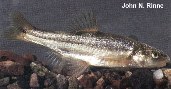
Afterflossenweichstrahlen: 7. Agosia chrysogaster can be distinguished by its elongated lower lobe on anal fin in large female, 70-95 small lateral scales, small barbell at corner of mouth, long coiled intestine, black peritoneum, rounded snout, slightly subterminal mouth, dorsal fin origin above or slightly in front of pelvic fin origin, 7 anal rays, pharyngeal teeth 0,4-4.0. Color consists of dark gray above, dusky black band along silver side enlarged into black spot at caudal fin base, often gold flecks on side. Large male is light yellow below, with yellow paired fin bases, large dorsal fin (Ref. 86798).
Body shape (shape guide): fusiform / normal.
Adults inhabit shallow sandy and rocky runs, flowing pools of creeks and small to medium rivers. They often occur near cover (Ref. 86798). Migratory behaviour is undetermined (Ref. 126106).
Lebenszyklus und Paarungsverhalten
Geschlechtsreife | Fortpflanzung | Ablaichen | Eier | Fruchtbarkeit | Larven
Page, L.M. and B.M. Burr, 2011. A field guide to freshwater fishes of North America north of Mexico. Boston : Houghton Mifflin Harcourt, 663p. (Ref. 86798)
IUCN Rote Liste Status (Ref. 130435: Version 2025-2 (Global))
Bedrohung für Menschen
Harmless
Nutzung durch Menschen
Tools
Zusatzinformationen
Download XML
Internet Quellen
Schätzungen auf der Grundlage von Modellen
Phylogenetischer Diversitätsindex (Ref.
82804): PD
50 = 1.0000 [Uniqueness, from 0.5 = low to 2.0 = high].
Bayesian length-weight: a=0.00871 (0.00401 - 0.01893), b=3.06 (2.88 - 3.24), in cm total length, based on LWR estimates for this (Sub)family-body shape (Ref.
93245).
Trophische Ebene (Ref.
69278): 2.9 ±0.4 se; based on size and trophs of closest relatives
Widerstandsfähigkeit (Ref.
120179): hoch, Verdopplung der Population dauert weniger als 15 Monate. (Preliminary K or Fecundity.).
Anfälligkeit der Fischerei (Ref.
59153): Low vulnerability (10 of 100).
🛈