>
Cypriniformes (Carps) >
Xenocyprididae (East Asian minnows)
Etymology: Hypophthalmichthys: Greek, hypo = under + Greek, ophthalmos = eye + Greek, ichthys = fish (Ref. 45335); molitrix: molitrix, approximately grinder (referring to the pharyngeal grinding apparatus) (Ref. 10294).
More on author: Valenciennes.
Ambiente: milieu / zona climática / intervalo de profundidade / gama de distribuição
Ecologia
; Água doce; estuarina bentopelágico; potamódromo (Ref. 126106); intervalo de profundidade 0 - 20 m (Ref. 6898). Subtropical; 6°C - 30°C (Ref. 37797); 63°N - 8°N, 73°E - 148°E (Ref. 120939)
Asia: Native to most major Pacific dainages of East Asia from Amur to Xi Jiang, China (Ref. 59043) and Hanoi, Vietman (Ref. 120939). Introduced around the world for aquaculture and control of algal blooms. Several countries report adverse ecological impact after introduction (Ref. 1739). Often confused with Hypophthalmichthys nobilis (Ref. 59043).
Comprimento na primeira maturidade / Tamanho / Peso / Idade
Maturidade: Lm 51.7 range ? - ? cm
Max length : 120 cm TL macho/indeterminado; (Ref. 86798); common length : 18.0 cm SL macho/indeterminado; (Ref. 35840); peso máx. Publicado: 50.0 kg (Ref. 30578); Idade máx. registada: 20 anos (Ref. 121658)
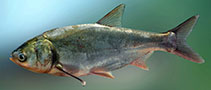
Espinhos dorsais (total) : 0; Raios dorsais moles (total) : 7 - 10; Espinhos anais: 0; Raios anais moles: 11 - 17. Diagnosis: Body olivaceous to silvery. Barbels absent. Keels extend from isthmus to anus. Edge of last simple dorsal ray not serrated. Branched anal rays 12-13.5 (Ref. 13274). It differs from Hypophthalmichthys nobilis by having sharp scaleless keel from pectoral region to anal origin, 650-820 long, slender gill rakers, head length 24-29% of standard length, and plain pale coloration, greenish grey above, whitish below (Ref. 59043).
Body shape (shape guide): fusiform / normal; Cross section: oval.
Adults are found in their natural range in rivers with marked water-level fluctuations and overwinters in middle and lower stretches, swimming just beneath the surface. They feed in shallow (0.5-1.0 m deep) and warm (over 21°C) backwaters, lakes and flooded areas with slow current on phytoplankton and zooplankton (Ref. 30578, 10294). Bigger individuals from about 1.5 cm SL feed only on phytoplankton while larvae and small juveniles prey on zooplankton (Ref. 59043). Breeding occurs in rivers or tributaries over shallow rapids with gravel or sand bottom, in upper water layer or even at surface during floods when the water level increases by 50-120 cm above normal level. Conditions for spawning include high current (0.5-1.7 m/s), turbid water, temperatures above 15°C (usually 18-26°C) and high oxygen concentrations (Ref. 59043). Spawning ceases if conditions change (especially sensitive to water-level fall) and resumes again when water level increases. Juveniles and adults form large schools during spawning season. Mature individuals undertake long distance upriver migration at start of a rapid flood and water-level increase, able to leap over obstacles up to 1 m. After spawning, adults migrate to foraging habitats, In autumn, adults move to deeper places in main course of river where they remain without feeding. Larvae drift downstream and settle in floodplain lakes, shallow shores and backwaters with little or no current (Ref. 59043). In aquaculture, it can survive brackish water (up to 7 ppt) when released into estuaries and coastal lakes (Ref. 59043). Escape from fish farms are widely known even as they are stocked in large rivers and almost all still water bodies like lakes and ponds. Utilized fresh for human consumption and also introduced to many countries where its ability to clean reservoirs and other waters of clogging algae is appreciated even more than its food value (Ref. 9987). One of among 3 or 4 species of cyprinids whose world production in aquaculture exceeds 1 million tons per year (Ref. 30578).
Skelton, P.H., 1993. A complete guide to the freshwater fishes of southern Africa. Southern Book Publishers. 388 p. (Ref. 7248)
Categoria na Lista Vermelha da IUCN (Ref. 130435: Version 2025-2 (Global))
Ameaça para o homem
Potential pest
Utilização humana
Pescarias: espécies comerciais; Aquacultura: espécies comerciais
Ferramentas
Relatórios especiais
Descarregue XML
Fontes da internet
Estimativas baseadas em modelos
Índice de diversidade filogenética (Ref.
82804): PD
50 = 0.6250 [Uniqueness, from 0.5 = low to 2.0 = high].
Bayesian length-weight: a=0.00891 (0.00773 - 0.01027), b=3.10 (3.06 - 3.14), in cm total length, based on LWR estimates for this species (Ref.
93245).
Nível Trófico (Ref.
69278): 2.3 ±0.1 se; based on diet studies.
Generation time: 5.6 (4.5 - 6.8) years. Estimated as median ln(3)/K based on 10
growth studies.
Resiliência (Ref.
120179): Médio, tempo mínimo de duplicação da população 1,4 - 4,4 anos (K=0.16-0.29; tm=2-6).
Vulnerabilidade da pesca (Ref.
59153): High vulnerability (55 of 100).
🛈
Nutrientes (Ref.
124155): Calcium = 37.9 [16.1, 116.8] mg/100g; Iron = 1.37 [0.69, 2.65] mg/100g; Protein = 17.3 [16.1, 18.5] %; Omega3 = 0.306 [0.176, 0.554] g/100g; Selenium = 30.1 [16.4, 59.9] μg/100g; VitaminA = 8.45 [2.15, 37.85] μg/100g; Zinc = 0.445 [0.263, 0.805] mg/100g (wet weight); based on
nutrient studies.