>
Holocentriformes (Squirrelfishes, soldierfishes) >
Holocentridae (Squirrelfishes, soldierfishes) > Holocentrinae
Etymology: Sargocentron: Greek, sargos = sargus + Greek, kentron = sting (Ref. 45335).
Environnement : milieu / zone climatique / profondeur / gamme de distribution
Écologie
marin récifal; profondeur 10 - 45 m (Ref. 30874). Tropical
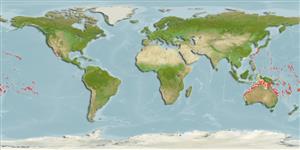
Indo-Pacific: Christmas Island in the eastern Indian Ocean to Australia eastward to Fiji and Samoa. Recently recorded from the Chesterfield Islands (Ref. 11897).
Taille / Poids / Âge
Maturité: Lm ? range ? - ? cm
Max length : 20.0 cm TL mâle / non sexé; (Ref. 90102)
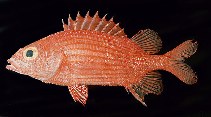
Épines dorsales (Total) : 11; Rayons mous dorsaux (Total) : 12 - 14; Épines anales: 4; Rayons mous anaux: 8 - 9. Body light red to orange-red with narrow darker red stripes separating scale rows; white streak on head absent (except beneath maxilla); 4-5 oblique scale rows on cheek; body depth 2.65-2.95 in SL; head length (HL) 2.55-2.8 in SL; snout length 3.8-4.15 in HL; interorbital width 5.25-6.35 in HL; dorsal head profile slightly convex; maxilla extending to between verticals at front edge of iris and center of eye; upper jaw length 2.35-2.6 in HL; rounded anterior end of nasal bone; medial margin of nasal bone without retrorse spine; moderately large nasal fossa without spines; upper surface of nasal bone between nasal fossa and premaxillary groove edge with a retrorse spine; 2 opercular spines, with the lower 1/2-3/4 length of the upper; preopercular spine 4.8-6.35 HL; spinules on posterior margin of preopercle 17 (3.3 cm SL specimen), 19 (4.9 cm), 26 (5.3 cm), 30-36 (6.4-8.1 cm); 4th to 6th dorsal spines subequal, the longest, 2.3-2.65 in HL; 3rd anal spine 1.5-1.95 in HL; broadly rounded caudal-fin lobes (Ref. 27370).
Body shape (shape guide): fusiform / normal; Cross section: compressed.
Nocturnal. Minimum depth reported taken from Ref. 11897. Solitary and cryptic, found in outer reef slopes of oceanic islands, mainly in the South Pacific (Ref 90102).
Cycle de vie et comportement reproducteur
Maturité | Reproduction | Frai | Œufs | Fécondité | Larves
Randall, J.E., 1998. Revision of the Indo-Pacific squirrelfishes (Beryciformes: Holocentridae: Holocentrinae) of the genus Sargocentron, with descriptions of four new species. Indo-Pac. Fish. (27):105 p. (Ref. 27370)
Statut dans la liste rouge de l'IUCN (Ref. 130435: Version 2025-2 (Global))
Menace pour l'homme
Harmless
Utilisations par l'homme
Pêcheries: sans intérêt
Outils
Articles particuliers
Télécharger en XML
Sources Internet
Estimations basées sur des modèles
Température préférée (Réf.
123201): 23.1 - 28.7, mean 27.2 °C (based on 154 cells).
Indice de diversité phylogénétique (Réf.
82804): PD
50 = 0.5000 [Uniqueness, from 0.5 = low to 2.0 = high].
Bayesian length-weight: a=0.01698 (0.00810 - 0.03560), b=2.96 (2.79 - 3.13), in cm total length, based on LWR estimates for this Genus-body shape (Ref.
93245).
Niveau trophique (Réf.
69278): 4.1 ±0.68 se; based on food items.
Résilience (Réf.
120179): Haut, temps minimum de doublement de population inférieur à 15 mois (Preliminary K or Fecundity.).
Vulnérabilité de la pêche (Ref.
59153): Low vulnerability (10 of 100).
🛈
Nutriments (Ref.
124155): Calcium = 64.6 [24.5, 255.3] mg/100g; Iron = 0.545 [0.212, 1.665] mg/100g; Protein = 18.8 [17.6, 20.0] %; Omega3 = 0.163 [0.070, 0.380] g/100g; Selenium = 31.5 [17.3, 65.0] μg/100g; VitaminA = 82.6 [29.8, 245.6] μg/100g; Zinc = 1.75 [0.72, 3.35] mg/100g (wet weight);