>
Aulopiformes (Grinners) >
Anotopteridae (Daggertooth)
Etymology: Anotopterus: Greek, a = without + Greek, noton = back + Greek, pteron = fin (Ref. 45335); pharao: pharao because of its resemblance to Egyptian kings (Ref. 6885).
Umwelt: Milieu / Klimazone / Tiefenbereich / Verbreitungsgebiet
Ökologie
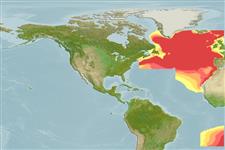
seewasser bathypelagisch; tiefenbereich 0 - 5100 m (Ref. 58018). Deep-water; 66°N - 27°S, 69°W - 1°W (Ref. 31260)
North Atlantic: from Canada (Ref. 5951), Greenland and Davis Strait, to Madeira I. and Canary Is. (Ref. 31260).
Größe / Gewicht / Alter
Geschlechtsreife: Lm ? range ? - ? cm
Max length : 96.0 cm SL Männchen/unbestimmt; (Ref. 31260)
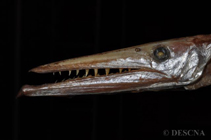
Afterflossenweichstrahlen: 12 - 15; Wirbelzahl: 77 - 81. In adults, head depth 23.2-26.8% of lower jaw length. Postorbital area 5.5-7.6% SL or 28.8-33.3% (less than 3 times smaller than HL). Rear edge of gill cover overlaps with the middle of the 4th vertebrae. Postadipose distance 6-7.4% SL (Ref. 31260).
Body shape (shape guide): elongated; Cross section: compressed.
Epimesopelagic species. Juveniles and fry observed exclusively within the central-circle current and its periphery; large adults caught mainly in boreal and sub-arctic waters. Feeds mainly on small and moderate-sized mesopelagic fishes; the largest Paralepis coregonoides and Arctozenus risso, had body length of 28-30 cm; a specimen caught from the southern region of Reykjanes Ridge had 12 individuals of Sebastes mentella ranging from 4.5-5 cm. Stomachs of those caught in the Mid-Atlantic Ridge have small squids (Ref. 31260).
Lebenszyklus und Paarungsverhalten
Geschlechtsreife | Fortpflanzung | Ablaichen | Eier | Fruchtbarkeit | Larven
Kukuev, E.I., 1998. Systematics and distribution in the world ocean of daggertooth fishes of the genus Anotopterus (Anotopteridae, Aulopiformes). J. Ichthyol. 38(9):716-729. (Ref. 31260)
IUCN Rote Liste Status (Ref. 130435: Version 2025-2 (Global))
Bedrohung für Menschen
Harmless
Nutzung durch Menschen
Tools
Zusatzinformationen
Download XML
Internet Quellen
Schätzungen auf der Grundlage von Modellen
Bevorzugte Temperatur (Ref.
123201): 3.2 - 8.4, mean 3.9 °C (based on 759 cells).
Phylogenetischer Diversitätsindex (Ref.
82804): PD
50 = 0.7500 [Uniqueness, from 0.5 = low to 2.0 = high].
Bayesian length-weight: a=0.00389 (0.00180 - 0.00842), b=3.12 (2.94 - 3.30), in cm total length, based on all LWR estimates for this body shape (Ref.
93245).
Trophische Ebene (Ref.
69278): 4.3 ±0.76 se; based on food items.
Widerstandsfähigkeit (Ref.
120179): niedrig, Verdopplung der Population dauert 4,5 - 14 Jahre. (Assuming tmax>10).
Anfälligkeit der Fischerei (Ref.
59153): High to very high vulnerability (70 of 100).
🛈