>
Blenniiformes (Blennies) >
Blenniidae (Combtooth blennies) > Salariinae
Etymology: Istiblennius: Greek, istios = sail + Greek, blennios = mucus (Ref. 45335).
Eponymy: Howard I Cole (1892–1966) was Chief Chemist for the Philippine Health Service at the leper colony on Culion Island, Philippines, the type locality. [...] (Ref. 128868), visit book page.
More on author: Herre.
Ambiente: milieu / zona climatica / distribuzione batimetrica / gamma di distribuzione
Ecologia
marino demersale; distribuzione batimetrica ? - 2 m (Ref. 83651). Tropical
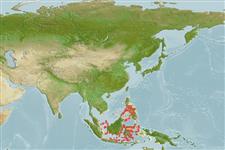
Western Pacific: known only from Culion and Panay islands, Philippines.
Dimensione / Peso / Età
Maturità: Lm ? range ? - ? cm
Max length : 11.8 cm SL maschio/sesso non determinato; (Ref. 9962); 10.3 cm SL (female)
Breve descrizione
Chiavi di identificazione | Morfologia | Morfometria
Spine dorsali (totale) : 13 - 15; Raggi dorsali molli (totale) : 18 - 20; Spine anali: 2; Raggi anali molli: 19 - 21. Dorsal fin XIII to XV, 18 to 20 (usually XIV); membrane between spinous and segmented-ray portions notched deeper than half length of first segmented ray; membrane from posteriormost ray attaching to point ranging from between dorsal edge of caudal peduncle well in advance of caudal-fin base to dorsal edge of caudal fin just posterior to base (usually anterior to caudal-fin base); posteriormost anal-fin ray not bound by membrane to caudal peduncle; skin covering anal-fin spines and anterior segmented rays not modified in adult males; pectoral-fin rays 14 or 15 (15 only unilaterally, in only 2 of 46 specimens examined for character); dorsal procurrent caudal fin rays 6 to 8 (typically 7), ventral procurrent rays 6 to 8 (typically 7), total procurrent rays 12 to 15 (typically 14), segmented rays 13. Lacking nape cirrus. Orbital cirrus consisting of flattened central stalk with up to 7 branches on each lateral and medial margin; less than orbital diameter in females, ranging from less than to slightly greater than orbital diameter in males. Nasal cirrus short, ranging from ragged-edged flap to palmate flap with up to 16 irregular branches; lacking posterior canines; ventral margin of upper lip entire; dorsal margin of lower lip varying from entire to weakly, irregularly, and almost unnoticeably crenulate (irregularities almost entirely restricted to corners of lip). Males with well-developed, blade-like crest on head; females lack crest, but females generally at 6.8 to 8.6 cm SL with faint, ridge-like crest precursors; male crest uniformly dusky or covered with dusky spots or granular vermiculations; remainder of head either almost uniformly dusky or with fine, dusky spots on opercle. Male max. size 11.8 cm SL; female max. size, 10.3 cm SL.
Body shape (shape guide): elongated; Cross section: oval.
Facultative air-breathing (Ref. 126274); Oviparous. Eggs are demersal and adhesive (Ref. 205), and are attached to the substrate via a filamentous, adhesive pad or pedestal (Ref. 94114). Larvae are planktonic, often found in shallow, coastal waters (Ref. 94114).
Ciclo vitale e comportamento di accoppiamento
Maturità | Riproduzione | Deposizione | Uova | Fecondità | Larve
Oviparous, distinct pairing (Ref. 205).
Springer, V.G. and J.T. Williams, 1994. The Indo-West Pacific blenniid fish genus Istiblennius reappraised: a revision of Istiblennius, Blenniella, and Paralticus, new genus. Smithson. Contrib. Zool. 565:1-193. (Ref. 9962)
Stato della Lista Rossa IUCN (Ref. 130435: Version 2025-2 (Global))
Minaccia per l'uomo
Harmless
Usi umani
Strumenti
Rapporti speciali
Scarica XML
Fonti Internet
Stime basate su modelli
Temperatura preferita (Fonte Biblio.
123201): 28.4 - 29.2, mean 28.8 °C (based on 316 cells).
Indice di diversità filogenetica (Fonte Biblio.
82804): PD
50 = 0.5001 [Uniqueness, from 0.5 = low to 2.0 = high].
Bayesian length-weight: a=0.00776 (0.00354 - 0.01702), b=3.00 (2.81 - 3.19), in cm total length, based on LWR estimates for this (Sub)family-body shape (Ref.
93245).
Livello trofico (Fonte Biblio.
69278): 2.0 ±0.00 se; based on food items.
Resilienza (Fonte Biblio.
120179): Alto, tempo minimo di raddoppiamento della popolazione meno di 15 mesi (Preliminary K or Fecundity.).
Vulnerabilità della pesca (Ref.
59153): Low vulnerability (10 of 100).
🛈