>
Aulopiformes (Grinners) >
Synodontidae (Lizardfishes) > Synodontinae
Etymology: Trachinocephalus: Greek, trachys, -eia, -ys = rough + Greek, kephale = head (Ref. 45335).
More on author: Forster.
Environnement : milieu / zone climatique / profondeur / gamme de distribution
Écologie
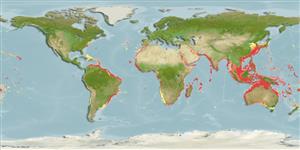
marin récifal; profondeur 0 - 400 m (Ref. 110386), usually 3 - 90 m (Ref. 4472). Tropical; 40°N - 40°S, 76°W - 154°W
Atlantic Ocean: Western Atlantic Ocean from Cape Cod, Massachusetts to Brazil, including Bermuda, Bahamas, Antilles and Gulf of Mexico). Eastern Atlantic from Mauritania to Gabon, including Saint Helena and Ascension Islands.
Taille / Poids / Âge
Maturité: Lm ? range ? - ? cm
Max length : 32.6 cm TL mâle / non sexé; (Ref. 55642); âge max. reporté: 7 années (Ref. 36558)
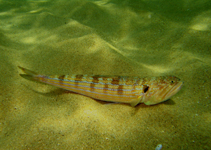
This species is distinguished from its congeners by the following characters: snout length (LSn) 53.2-117.0% eye diameter (DE), mean 79.1% (vs. mean 40.1% in T. gauguini and 74.8% in T. trachinus); LSn 13.5-27.0% body depth (DB), mean 21.6 (vs. mean 14.7% in T. gauguini); interorbital width 3.4-11.9%, mean 8.9% LH (vs. mean 5.6% in T. gauguini); DE 10.8-21.7% LH, mean 15.7% (vs. mean 16·6% in T. trachinus); length
of the last dorsal-fin ray 7.3-11.6% LS, mean 9·4% (vs. mean 10.1% in T. trachinus and 10.8% in T. gauguini); anal-fin rays 13-16, mode 15 (vs. mode 14 in T. gauguini and 16 in T. trachinus); pectoral-fin rays 11-13, mode 12 (vs. mode 11 in T. gauguini); lateral-line scales 53-60, mode 57 (vs. mode 56 in T. gauguini); predorsal scales 15-20, mode 17 (vs. mode 16 in T. trachinus); further differs from T. gauguini and T. trachinus by deep mitochondrial distances (16.9-17.6 and 15.1-17.8%, respectively) (Ref. 110386).
Cross section: oval.
Rest on or more often burrow into substrate, leaving eyes exposed (Ref. 4472).
Cycle de vie et comportement reproducteur
Maturité | Reproduction | Frai | Œufs | Fécondité | Larves
Polanco, F.A., P.A. Acero and R. Betancur-R, 2016. No longer a circumtropical species: revision of the lizardfishes in the Trachinocephalus myops species complex, with description of a new species from the Marquesas Islands. J. Fish Biol. 89(2):1302-1323. (Ref. 110386)
Statut dans la liste rouge de l'IUCN (Ref. 130435: Version 2025-2 (Global))
Menace pour l'homme
Harmless
Utilisations par l'homme
Pêcheries: intérêt commercial mineur
Outils
Articles particuliers
Télécharger en XML
Sources Internet
Estimations basées sur des modèles
Température préférée (Réf.
123201): 18.9 - 29, mean 27.3 °C (based on 4584 cells).
Indice de diversité phylogénétique (Réf.
82804): PD
50 = 0.5625 [Uniqueness, from 0.5 = low to 2.0 = high].
Bayesian length-weight: a=0.00363 (0.00235 - 0.00561), b=3.36 (3.23 - 3.49), in cm total length, based on LWR estimates for this species & (Sub)family-body (Ref.
93245).
Niveau trophique (Réf.
69278): 4.4 ±0.4 se; based on diet studies.
Résilience (Réf.
120179): Milieu, temps minimum de doublement de population : 1,4 à 4,4 années (K=1.6; tm=2; tmax=7).
Vulnérabilité de la pêche (Ref.
59153): Low vulnerability (23 of 100).
🛈
Nutriments (Ref.
124155): Calcium = 34.5 [11.1, 70.8] mg/100g; Iron = 0.364 [0.127, 0.946] mg/100g; Protein = 15.4 [12.9, 17.8] %; Omega3 = 0.0732 [, ] g/100g; Selenium = 48.8 [18.4, 109.3] μg/100g; VitaminA = 77.6 [17.7, 284.8] μg/100g; Zinc = 0.871 [0.520, 1.341] mg/100g (wet weight);