>
Eupercaria/misc (Various families in series Eupercaria) >
Labridae (Wrasses) > Julidinae
Etymology: Thalassoma: Greek, thalassa = the sea + Greek, soma = body; the colour of the sea (Ref. 45335).
More on author: Boulenger.
Environnement : milieu / zone climatique / profondeur / gamme de distribution
Écologie
marin récifal; profondeur 0 - 60 m (Ref. 49354), usually 2 - 5 m (Ref. 40101). Tropical
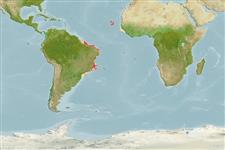
Western Atlantic: Brazil and its oceanic islands (Ref. 40101, 49354).
Taille / Poids / Âge
Maturité: Lm ? range ? - ? cm
Max length : 13.3 cm SL mâle / non sexé; (Ref. 49354)
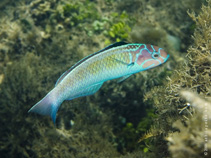
Generally a plankton-eater. Found on deep reefs (40-60 m), where it is recorded inside the lumen of tubular sponges (Ref. 39606). At Fernando de Noronha and Trindade Islands, groups of 10-450 initial-phase individuals clean other fishes in the water column close to the reef bottom and pinnacles (Ref. 36301, 49354). Also at Fernando de Noronha Archipelago, juveniles follow foraging green turtles (Chelonia mydas) and pick off particles stirred from the bottom by the turtle’s activity (Ref. 51385). Fish clients include about 20 species of surgeonfishes, damselfishes, parrotfishes, grunts, and even small groupers such as coneys. Occasionally, a coney (Cephalopholis fulva) preys on isolated Noronha wrasses out and away from the cleaning stations. Coastal individuals were never recorded cleaning. Strictly diurnal, this wrasse is one of the last reef fishes to emerge from nocturnal shelters and one of the first to retreat (Ref. 36301). Initial-phase individuals are predominantly dark-brown and white, whereas terminal-phase males are blue and purple. A group-spawner throughout the year, adult females form harems dominated by a few terminal-phase males. Pair spawning is also recorded for this wrasse (Ref. 49354). Traded as an aquarium fish at Ceará, Brazil (Ref. 49392).
Cycle de vie et comportement reproducteur
Maturité | Reproduction | Frai | Œufs | Fécondité | Larves
Oviparous, distinct pairing during breeding (Ref. 205).
Lubbock, R. and A. Edwards, 1981. The fishes of Saint Paul's Rocks. J. Fish Biol. 18(2):135-157. (Ref. 13121)
Statut dans la liste rouge de l'IUCN (Ref. 130435: Version 2025-2 (Global))
Menace pour l'homme
Harmless
Utilisations par l'homme
Pêcheries: commercial; Aquarium: Commercial
Outils
Articles particuliers
Télécharger en XML
Sources Internet
Estimations basées sur des modèles
Température préférée (Réf.
123201): 23.8 - 27.6, mean 27 °C (based on 184 cells).
Indice de diversité phylogénétique (Réf.
82804): PD
50 = 0.5000 [Uniqueness, from 0.5 = low to 2.0 = high].
Bayesian length-weight: a=0.00661 (0.00334 - 0.01306), b=3.15 (2.96 - 3.34), in cm total length, based on LWR estimates for this species & (Sub)family-body (Ref.
93245).
Niveau trophique (Réf.
69278): 3.5 ±0.4 se; based on size and trophs of closest relatives
Résilience (Réf.
120179): Haut, temps minimum de doublement de population inférieur à 15 mois (Preliminary K or Fecundity.).
Vulnérabilité de la pêche (Ref.
59153): Low vulnerability (10 of 100).
🛈