>
Kurtiformes (Nurseryfishes, cardinalfishes.) >
Apogonidae (Cardinalfishes) > Apogoninae
Etymology: Apogon: Greek, a = without + Greek pogon = chin, beard (Ref. 45335).
More on author: Castelnau.
Umwelt: Milieu / Klimazone / Tiefenbereich / Verbreitungsgebiet
Ökologie
seewasser demersal; tiefenbereich 0 - 70 m (Ref. 13121), usually 0 - 35 m (Ref. 40849). Tropical; - 24°S
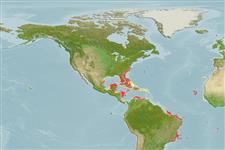
Southwest Atlantic and Eastern Central Atlantic: Brazil, including Fernando de Noronha Archipelago and St. Paul's Rocks.
Größe / Gewicht / Alter
Geschlechtsreife: Lm ? range ? - ? cm
Max length : 10.1 cm SL Männchen/unbestimmt; (Ref. 13121)
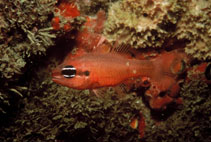
Maximum depth from Ref. 126840. Inhabits rock pools but also found to depths of at least 50 m. Hides in holes and crevices during the day (Ref. 13121). Feeds on plankton (Ref. 40849).
Lebenszyklus und Paarungsverhalten
Geschlechtsreife | Fortpflanzung | Ablaichen | Eier | Fruchtbarkeit | Larven
Mouthbrooders (Ref. 240). Distinct pairing during courtship and spawning (Ref. 205).
Lubbock, R. and A. Edwards, 1981. The fishes of Saint Paul's Rocks. J. Fish Biol. 18(2):135-157. (Ref. 13121)
IUCN Rote Liste Status (Ref. 130435: Version 2025-2 (Global))
Bedrohung für Menschen
Harmless
Nutzung durch Menschen
Tools
Zusatzinformationen
Download XML
Internet Quellen
Schätzungen auf der Grundlage von Modellen
Bevorzugte Temperatur (Ref.
123201): 24.7 - 28, mean 27 °C (based on 366 cells).
Phylogenetischer Diversitätsindex (Ref.
82804): PD
50 = 0.5000 [Uniqueness, from 0.5 = low to 2.0 = high].
Bayesian length-weight: a=0.01514 (0.00700 - 0.03275), b=3.07 (2.89 - 3.25), in cm total length, based on LWR estimates for this (Sub)family-body shape (Ref.
93245).
Trophische Ebene (Ref.
69278): 3.4 ±0.45 se; based on food items.
Widerstandsfähigkeit (Ref.
120179): hoch, Verdopplung der Population dauert weniger als 15 Monate. (Preliminary K or Fecundity.).
Anfälligkeit der Fischerei (Ref.
59153): Low vulnerability (10 of 100).
🛈