>
Aulopiformes (Grinners) >
Synodontidae (Lizardfishes) > Synodontinae
Etymology: Synodus: Greek, syn, symphysis = grown together + Greek, odous = teeth (Ref. 45335).
More on author: Ayres.
Umwelt: Milieu / Klimazone / Tiefenbereich / Verbreitungsgebiet
Ökologie
seewasser riff-verbunden; tiefenbereich 1 - 229 m (Ref. 2850), usually 2 - 50 m (Ref. 9348). Subtropical; 51°N - 2°S, 128°W - 88°W
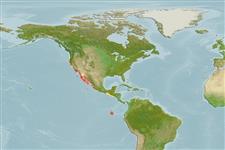
Eastern Pacific: San Francisco, USA to Cabo San Lucas and Guayamas, Mexico. Reported from British Columbia (Ref. 11980) and the Galapagos Islands (Ref. 5227).
Größe / Gewicht / Alter
Geschlechtsreife: Lm ? range ? - ? cm
Max length : 64.0 cm TL Männchen/unbestimmt; (Ref. 9348); common length : 30.0 cm TL Männchen/unbestimmt; (Ref. 9348)
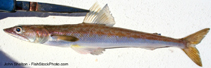
Rückenflossenstacheln (insgesamt) : 0; Rückenflossenweichstrahlen (insgesamt) : 11 - 13; Afterflossenstacheln: 0; Afterflossenweichstrahlen: 12 - 15; Wirbelzahl: 60 - 63. Most species are brown to gray or red dorsally and laterally and pale ventrally; some species have a pattern of dusky saddles, lateral spots, or bars (Ref. 35938).
Body shape (shape guide): elongated; Cross section: circular.
Perch motionless on pectoral fins in a wide range of habitats; commonly found on sandy bottoms or sand patches around rocky reefs and boulder and gravel strewn slopes. Active during the day. May bury in sand with only the eyes and mouth protruding (Ref. 5227). Feed on fishes (Ref. 9348). Oviparous, with planktonic eggs and larvae (Ref. 35938). Extended larval period (Ref. 35938). Catches are either discarded or made into fish meal (Ref. 9348).
Lebenszyklus und Paarungsverhalten
Geschlechtsreife | Fortpflanzung | Ablaichen | Eier | Fruchtbarkeit | Larven
Eschmeyer, W.N., E.S. Herald and H. Hammann, 1983. A field guide to Pacific coast fishes of North America. Boston (MA, USA): Houghton Mifflin Company. xii+336 p. (Ref. 2850)
IUCN Rote Liste Status (Ref. 130435: Version 2025-2 (Global))
Bedrohung für Menschen
Harmless
Nutzung durch Menschen
Fischereien: nicht kommerziell
Tools
Zusatzinformationen
Download XML
Internet Quellen
Schätzungen auf der Grundlage von Modellen
Bevorzugte Temperatur (Ref.
123201): 15.2 - 25.9, mean 21.6 °C (based on 58 cells).
Phylogenetischer Diversitätsindex (Ref.
82804): PD
50 = 0.5000 [Uniqueness, from 0.5 = low to 2.0 = high].
Bayesian length-weight: a=0.00490 (0.00310 - 0.00773), b=3.11 (2.98 - 3.24), in cm total length, based on LWR estimates for this species & Genus-body shape (Ref.
93245).
Trophische Ebene (Ref.
69278): 4.5 ±0.80 se; based on food items.
Widerstandsfähigkeit (Ref.
120179): mittel, Verdopplung der Population dauert 1,4 - 4,4 Jahre. (Preliminary K or Fecundity.).
Anfälligkeit der Fischerei (Ref.
59153): Moderate to high vulnerability (46 of 100).
🛈
Nährstoffe (Ref.
124155): Calcium = 19.2 [6.2, 42.9] mg/100g; Iron = 0.412 [0.140, 0.958] mg/100g; Protein = 16.7 [13.7, 19.1] %; Omega3 = 0.0982 [, ] g/100g; Selenium = 22.5 [8.2, 52.2] μg/100g; VitaminA = 49.8 [12.1, 182.6] μg/100g; Zinc = 0.469 [0.266, 0.767] mg/100g (wet weight);