Miljö: miljö / Klimatzon / djupintervall / distributionsområde
Ekologi
; sötvatten; brackvatten bentopelagisk; pH range: 7.0 - 7.5; dH range: 10 - 15; flodvandrande (Ref. 51243); djupintervall 15 - ? m. Subtropical; 10°C - 20°C (Ref. 1672); 71°N - 36°N, 10°W - 155°E
Europe: north to Pyrenees and Alps, eastward to Ural and Eya drainages (Caspian basin); Aegean basin in Pinios, Vardar, Vegoritis, Kastoria, Struma and Maritza drainages. Asia: Marmara basin and lower Sakarya in Anatolia, Aral basin, and Siberia from Ob eastward to Lena drainages. Naturally absent from Iberian Peninsula, Adriatic basin, Italy, Great Britain north of 56 N, Scandinavia north of 69° N. Locally introduced in Spain; introduced and invasive in northeastern Italy. At least one country reports adverse ecological impact after introduction.
Längd vid första mognad / Storlek / Vikt / Ålder
Könsmognad: Lm 14.0, range 8 - ? cm
Max length : 50.2 cm TL hane/ej könsbestämd; (Ref. 88166); common length : 25.0 cm TL hane/ej könsbestämd; (Ref. 556); publicerad maxvikt: 1.8 kg (Ref. 4699); rapporterad maxålder: 14 år (Ref. 41616)
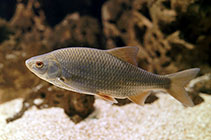
Taggstrålar i ryggfenan (totalt) : 3; Mjukstrålar i ryggfenan (totalt) : 9 - 12; Taggstrålar i analfenan: 3; Mjukstrålar i analfenan: 9 - 13; Ryggkotor: 39 - 41. The only species of the genus in Atlantic basin north of Pyrénées which can be distinguished from its congeners in Black and Caspian Sea basins and Apennine Peninsula by the combination of the following characters: 39-41 + 2-3 (41-44 total) scales along lateral line; dorsal and anal fins with 10½ branched rays; body laterally compressed, depth 25-35% SL; mouth terminal; snout pointed; iris from yellow in juveniles to deep red in adults; pectoral, pelvic and anal fins orange to red; and no midlateral stripe. Differs from its congeners in Balkan Peninsula by uniquely possessing 10½ branched anal rays (Ref. 59043). Caudal fin with 18-19 rays (Ref. 2196). Also Ref. 96829.
Body shape (shape guide): fusiform / normal.
Found in a wide variety of habitats, mainly in lowland areas. Most abundant in nutrient-rich lakes and large to medium sized rivers and backwaters. Also recorded from small lowland streams and from brackish coastal lagoons. In fast-flowing rivers, confined to stretches where backwaters or shelters allow for overwintering. Larvae and juveniles live in wide variety of littoral habitats. Preys predominantly on benthic invertebrates, zooplankton, plant material and detritus. May shift from littoral to pelagic habitats and between benthic food and zooplankton when abundance of a specific food item is high or for avoidance of predation and/or competition. Breeds among dense submerged vegetation in backwaters or lakes, flooded meadows or in shallow, fast-flowing river habitats on plant or gravel bottom. Undertakes short spawning migrations. Stays in backwaters or in deep parts of lakes to overwinter. Produces fertile hybrids with Abramis brama (Ref. 59043). Pale yellow eggs are found attached to vegetation and tree roots (Ref. 41678). There is only little commercial fishing for this species, but valued for recreational fishing. Utilized fresh and dried or salted; can be pan-fried, broiled and baked (Ref. 9988).
Spawns in shoals among dense among dense submerged vegetation in backwaters or lakes, flooded meadows or in shallow, fast-flowing river habitats on plant or gravel bottom. Eggs are sticky and hatch in about 12 days (Ref. 59043). Pale yellow eggs are attached to vegetation and tree roots (Ref. 41678).
Kottelat, M. and J. Freyhof, 2007. Handbook of European freshwater fishes. Publications Kottelat, Cornol and Freyhof, Berlin. 646 pp. (Ref. 59043)
Status på IUCN:s rödlista (Ref. 130435: Version 2025-2 (Global))
Hot mot människor
Potential pest (Ref. 59043)
Mänskliga användningsområden
Fiskeri: kommersiell; Vattenbruk: kommersiell; sportfisk: ja
Verktyg
Särskilda rapporter
Ladda ner XML
Internet-källor
Uppskattningar baserade på modeller
Index för fylogenetisk mångfald (Ref.
82804): PD
50 = 0.5020 [Uniqueness, from 0.5 = low to 2.0 = high].
Bayesian length-weight: a=0.00741 (0.00681 - 0.00807), b=3.16 (3.14 - 3.18), in cm total length, based on LWR estimates for this species (Ref.
93245).
Trofisk nivå (Ref.
69278): 3.0 ±0.0 se; based on diet studies.
Generation time: 7.6 (5.2 - 10.8) years. Estimated as median ln(3)/K based on 18
growth studies.
Resiliens (Ref.
120179): Mellan, lägsta populationsfördubblingstid 1,4-4,4 år (K=0.10-0.21; tm=2-3; tmax=12).
Sårbarhet i fisket (Ref.
59153): Moderate to high vulnerability (53 of 100).
🛈
Näringsämnen (Ref.
124155): Calcium = 17.5 [12.6, 29.9] mg/100g; Iron = 0.264 [0.172, 0.442] mg/100g; Protein = 19.1 [16.7, 21.3] %; Omega3 = 0.388 [0.215, 0.721] g/100g; Selenium = 4.51 [1.52, 13.51] μg/100g; VitaminA = 23.9 [10.2, 54.6] μg/100g; Zinc = 0.438 [0.324, 0.709] mg/100g (wet weight); based on
nutrient studies.