>
Anabantiformes (Gouramies, snakeheads) >
Osphronemidae (Gouramies) > Macropodusinae
Etymology: Betta: Malay/Javanese origin. Bleeker (1850, 1858) indicates Ikan Wadder Bettah as the local name of Betta trifasciata Bleeker, 1849 (now Betta picta, Valenciennes, 1846) in the Ambarawa Javanese dialect. Ikan Wader is a common Javanese name for smaller freshwater fishes, especially cyprinids (already used in Old Javanese). See Blust, R. & Trussel, S. Austronesian Comparative Dictionary. Web Edition (https://www.trussel2.com/acd/).
More on authors: Ng & Kottelat.
Ambiente: milieu / zona climatica / distribuzione batimetrica / gamma di distribuzione
Ecologia
; acqua dolce benthopelagico. Tropical
Asia: known from Selangor and Perak in Malaysia. Its range extends to Riau Archipelago, Indonesia (Ref. 56386).
Dimensione / Peso / Età
Maturità: Lm ? range ? - ? cm
Max length : 7.8 cm SL maschio/sesso non determinato; (Ref. 13093)
Breve descrizione
Chiavi di identificazione | Morfologia | Morfometria
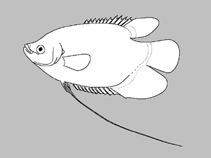
Spine dorsali (totale) : 1; Raggi dorsali molli (totale) : 8; Spine anali: 2; Raggi anali molli: 28. Differs from Betta chloropharynx in the following characters: horseshoe-shaped black throat mark (vs. µ-shaped black throat mark); presence of both dorsal and caudal transverse bars (vs. absence); more subdorsal scales (mode 6 1/2 vs. 5-6). It is distinguished from Betta renata in the following characters: horseshoe-shaped black throat mark (vs. kidney-shaped); non-spotted opercle (vs. spotted opercle); opercle with yellow or brown lower margin (vs. black margin); fewer postdorsal scales (mode 12 vs. 9 1/2); more anal fin rays (mode 30 vs. 29); more lateral scales (mode 32 vs. 31). Can be differentiated from Betta spilotogena in the following characters: horseshoe-shaped black throat mark ((vs. black median spot); non-spotted opercle (vs. spotted opercle); opercle with yellow or brown lower margin (vs. back margin); presence of both dorsal and caudal transverse bars (vs. absence); and more subdorsal scales (mode 6 1/2 vs. 5 1/2) (Ref. 56386).
Body shape (shape guide): fusiform / normal.
Facultative air-breathing (Ref. 126274); Occurs in backwater peat swamps with substrate usually peat and leaf litter. Large fish are found in the flowing sections of the blackwater streams and smaller ones appear to prefer pools and slower flowing waters.
Ciclo vitale e comportamento di accoppiamento
Maturità | Riproduzione | Deposizione | Uova | Fecondità | Larve
Ng, P.K.L. and M. Kottelat, 1994. Revision of the Betta waseri species group (Teleostei: Belontiidae). Raffles Bull. Zool. 42(3):593-611. (Ref. 13093)
Stato della Lista Rossa IUCN (Ref. 130435: Version 2025-2 (Global))
Minaccia per l'uomo
Harmless
Usi umani
Strumenti
Rapporti speciali
Scarica XML
Fonti Internet
Stime basate su modelli
Indice di diversità filogenetica (Fonte Biblio.
82804): PD
50 = 0.5000 [Uniqueness, from 0.5 = low to 2.0 = high].
Bayesian length-weight: a=0.01000 (0.00374 - 0.02675), b=2.97 (2.74 - 3.20), in cm total length, based on LWR estimates for this (Sub)family-body shape (Ref.
93245).
Livello trofico (Fonte Biblio.
69278): 3.3 ±0.4 se; based on size and trophs of closest relatives
Resilienza (Fonte Biblio.
120179): Alto, tempo minimo di raddoppiamento della popolazione meno di 15 mesi (Preliminary K or Fecundity.).
Vulnerabilità della pesca (Ref.
59153): Low vulnerability (10 of 100).
🛈