Klassifizierung / Names
Namen | Synonyme | Catalog of Fishes(Gattung, Arten) | ITIS | CoL | WoRMS | Cloffa
Umwelt: Milieu / Klimazone / Tiefenbereich / Verbreitungsgebiet
Ökologie
; süßwasser benthopelagisch; potamodrom (Ref. 51243). Tropical; 19°N - 9°N, 101°E - 108°E
Asia: Chao Phraya and Mekong basins in Thailand, Laos, Cambodia and Viet Nam.
Größe / Gewicht / Alter
Geschlechtsreife: Lm ? range ? - ? cm
Max length : 65.0 cm SL Männchen/unbestimmt; (Ref. 30857); max. veröff. Gewicht: 5.0 kg (Ref. 10431)
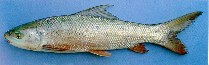
Rückenflossenstacheln (insgesamt) : 0; Rückenflossenweichstrahlen (insgesamt) : 15 - 16; Wirbelzahl: 40. Distinguished from other species of the genus in the area by its count of lateral line scales: 53-60 (Ref. 27732). A large species with very small scales, no barbels, and distinctive coloration. Juveniles silvery with red caudal fin, larger fish with head and body violaceous, rosy, or bluish and caudal fin dusky (Ref. 33488)
Body shape (shape guide): fusiform / normal.
Inhabits large rivers and lowland floodplains (Ref. 12693). Occurs in riffle and deep slow reaches (Ref. 37769). Moves out into the flooded forest where it feeds on leafy plant matter, phytoplankton and insects (Ref. 12693). Migration pattern is markedly different above and below the Khone Falls in the Mekong basin. Below the falls, it makes an upstream migration from Phnom Penh to the Khone Falls between November and February, consisting mainly of sub-adults of sizes 10 to 50 cm. From April to July, it migrates in the opposite direction, from Khone Falls and downstream, constituting mainly of sub-adults up to about 50 cm (Ref. 37770). Above the Khone Falls, from Klong Kaem District, Ubolratchatani in Thailand, fish migrates upstream in February; at Khemmaratch further upstream in Ubolratchatani, it moves upstream in March-April; and at Mukdahan, it goes upstream in May. However, it migrates downstream at Klong Kaem in June-July (Ref. 37770). Only downstream migrations are reported in the Mekong Delta in Viet Nam, constituting mainly of juveniles (2-20 cm), with the smallest fish mainly in June-July and fish between 10 and 20 mainly from September to November (Ref. 37770). From Xayabouri in Laos to Chiang Saen in Thailand, upstream migrations take place from March to August. This appears to be two distinct migrations: one of sub-adults measuring 15-50 cm during March-April and another one of larger fishes of sizes 40 to 90 cm during June-July (Ref. 37770). Not known to persist in impoundments. Individuals caught with dais or traps are often immediately kept alive in fish cages for future sale. Marketed fresh and sometimes dried and salted (Ref. 12693). Known to reach up to 15 kg in Thailand (Jean-Francois, pers. comm. 11/02).
Lebenszyklus und Paarungsverhalten
Geschlechtsreife | Fortpflanzung | Ablaichen | Eier | Fruchtbarkeit | Larven
Reproductive behavior assumed only. Replace ASAP (RF).
Roberts, T.R., 1997. Systematic revision of the tropical Asian labeon cyprinid fish genus Cirrhinus, with descriptions of new species and biological observations on C. lobatus. Nat. Hist. Bull. Siam Soc. 45:171-203. (Ref. 33488)
IUCN Rote Liste Status (Ref. 130435: Version 2025-2 (Global))
Bedrohung für Menschen
Harmless
Nutzung durch Menschen
Fischereien: kommerziell
Tools
Zusatzinformationen
Download XML
Internet Quellen
Schätzungen auf der Grundlage von Modellen
Phylogenetischer Diversitätsindex (Ref.
82804): PD
50 = 0.5020 [Uniqueness, from 0.5 = low to 2.0 = high].
Bayesian length-weight: a=0.00794 (0.00436 - 0.01448), b=3.00 (2.85 - 3.15), in cm total length, based on LWR estimates for this species & (Sub)family-body (Ref.
93245).
Trophische Ebene (Ref.
69278): 2.4 ±0.21 se; based on food items.
Widerstandsfähigkeit (Ref.
120179): mittel, Verdopplung der Population dauert 1,4 - 4,4 Jahre. (Assuming tm=2-4).
Anfälligkeit der Fischerei (Ref.
59153): Moderate to high vulnerability (52 of 100).
🛈