>
Cypriniformes (Carps) >
Cyprinidae (Minnows or carps) > Cyprininae
Etymology: Carassius: Latinization of , karass, karausche, European crucian carp (Ref. 45335); auratus: From the words carassius--Latin of karass (common name for these fishes in Eurasia) and auratus, meaning gilded (Ref. 10294).
More on author: Linnaeus.
Môi trường: môi trường / vùng khí hậu / Mức độ sâu / phạm vi phân phối
Sinh thái học
; nước ngọt; thuộc về nước lợ sống nổi và đáy; pH range: 6.0 - 8.0; dH range: 5 - 19; di cư trong nước ngọt (Ref. 126106); mức độ sâu 0 - 20 m (Ref. 6898). Subtropical; 0°C - 41°C (Ref. 35682); 53°N - 22°N
Asia: native in East Asia, China and Japan (Ref. 6390). Introduced elsewhere. throughout the world with reported adverse ecological impact after introduction.
Bộ gần gũi / Khối lượng (Trọng lượng) / Tuổi
Chín muồi sinh dục: Lm ? range ? - ? cm
Max length : 48.0 cm TL con đực/không giới tính; (Ref. 27549); common length : 10.0 cm TL con đực/không giới tính; (Ref. 9987); Khối lượng cực đại được công bố: 1.6 kg (Ref. 128900); Tuổi cực đại được báo cáo: 41 các năm (Ref. 72468)
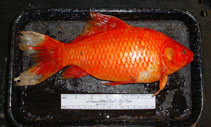
Các tia vây lưng cứng (tổng cộng) : 3 - 4; Các vây lưng mềm (tổng cộng) : 14 - 20; Tia cứng vây hậu môn: 2 - 3; Tia mềm vây hậu môn: 4 - 7; Động vật có xương sống: 30. Body stout, thick-set, caudal peduncle thick and short (Ref. 1998). Head without scales (Ref. 39167, 1998), broadly triangular (Ref. 1998), interorbital space broad, snout longer than eye diameter, maxillary reaching posterior nostril or not quite to eye (Ref. 39166), barbels lacking on upper jaw (Ref. 39104, 1998). Lateral line complete. Dorsal and anal fins with serrate bony spines, pelvic fins short, broad and thoracic. Nuptial tubercles of male fine, on opercle, sometimes on back and a few on pectoral fins. Hybridize readily with carp, hybrids intermediate in most characteristics (Ref. 1998). Caudal fin with 17-19 rays (Ref. 2196). Last simple anal ray osseous and serrated posteriorly; no barbels (Ref. 43281). Pigmentation: Wild-caught specimens, olive brown (Ref. 39168, 39104), slate olive, olive green, with a bronze sheen (Ref. 39104), silvery, grayish yellowish, gray-silver (Ref. 39169), through gold (often with black blotches) to creamy white (Ref. 1998); yellowish white or white below. Cultured forms vary through scarlet, red-pink, silver, brown, white, black and combinations of these colors (Ref. 39104).
Body shape (shape guide): fusiform / normal; Cross section: oval.
Adults inhabit rivers, lakes, ponds and ditches (Ref. 5258, 10294) with stagnant or slow-flowing water (Ref. 30578). They occur in eutrophic waters, well vegetated ponds and canals (Ref. 59043). Live better in cold water. Feed mainly on plankton, benthic invertebrates, plant material and detritus (Ref. 59043). Goldfish lay eggs on submerged vegetation. Females spawn multiple times during the spawning period (Ref. 88808). Oviparous, with pelagic larvae. They last long in captivity (Ref. 7248). Maximum recorded salinity is 17 ppt (Ref. 39171), but unable to withstand prolonged exposure above 15 ppt (Ref. 39172, 39174). Used as an experimental species (Ref. 4537). Valued as ornamental fish for ponds and aquaria; edible but rarely eaten (Ref. 9987). Aquarium keeping: in groups of 5 or more individuals; minimum aquarium size 100 cm (Ref. 51539). Reported individual hooked by an angler in a lake in Poole, Dorset measured 40 cm (16 in), weighing 2.3 kg (Practical Fishkeeping, 2010).
Cold water temperatures during the winter months are necessary for proper ova development (Ref. 44091). Spawning takes place in shallow water among weeds, often where willow roots grow exposed in water (Ref. 39171), also meadows inundated by spring flood (Ref. 39176). Spawning activity begin just before dawn (Ref. 39168), to midafternoon (Ref. 39177). Individual fish spawn 3-10 lots of eggs at intervals of 8-10 days (Ref. 39180). Juveniles need high temperature to grow. Eggs are sticky, attached to water plants or submerged objects (Ref. 59043). Females spawn multiple times during the spawning period (Ref. 88808).
Kottelat, M., A.J. Whitten, S.N. Kartikasari and S. Wirjoatmodjo, 1993. Freshwater fishes of Western Indonesia and Sulawesi. Periplus Editions, Hong Kong. 221 p. (Ref. 7050)
Tình trạng Sách đỏ IUCN (Ref. 130435: Version 2025-2 (Global))
Mối đe dọa đối với con người
Potential pest
Sử dụng của con người
Các nghề cá: tính thương mại; Nuôi trồng thủy sản: tính thương mại; cá để chơi: đúng; Bể nuôi cá: tính thương mại cao; mồi: occasionally
Các công cụ
Báo cáo đặc biệt
Tải xuống XML
Các nguồn internet
Ước tính dựa trên mô hình
Chỉ số đa dạng phát sinh loài (Tài liệu tham khảo
82804): PD
50 = 0.5156 [Uniqueness, from 0.5 = low to 2.0 = high].
Bayesian length-weight: a=0.01259 (0.01083 - 0.01464), b=3.04 (3.00 - 3.08), in cm total length, based on LWR estimates for this species (Ref.
93245).
Mức dinh dưỡng (Tài liệu tham khảo
69278): 2.0 ±0.0 se; based on diet studies.
Generation time: 6.7 ( na - na) years. Estimated as median ln(3)/K based on 2
growth studies.
Thích nghi nhanh (Tài liệu tham khảo
120179): Trung bình, thời gian nhân đôi của chủng quần tối thiểu là 1.4 - 4.4 năm (K=0.17; tm=1; tmax=30).
Sự dễ bị tổn thương của nghề đánh cá (Ref.
59153): Moderate vulnerability (37 of 100).
🛈