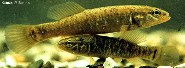
Klassifizierung / Names
Namen | Synonyme | Catalog of Fishes(Gattung, Arten) | ITIS | CoL | WoRMS | Cloffa
>
Esociformes (Pikes and mudminnows) >
Umbridae (Mudminnows)
Etymology: Umbra: Latin, umbra, -ae = shadow, in the sense of phantom; due to its quick movements (Ref. 45335); limi: limi meaning of the mud (Ref. 10294).
Umwelt: Milieu / Klimazone / Tiefenbereich / Verbreitungsgebiet
Ökologie
; süßwasser demersal; pH range: 6.0 - 6.5; dH range: 3 - 8; standorttreu (Ref. 126106). Temperate; 17°C - 22°C (Ref. 1672); 52°N - 36°N
North America: St. Lawrence-Great Lakes, Hudson Bay (Red River) and Mississippi River basins from Quebec to Manitoba in Canada and south to Ohio, Tennessee and Arkansas, USA; Hudson River drainage (Atlantic Slope) in New York, USA. Isolated populations in Missouri River drainage of South Dakota and Iowa, USA.
Größe / Gewicht / Alter
Geschlechtsreife: Lm ? range ? - ? cm
Max length : 14.0 cm TL Männchen/unbestimmt; (Ref. 5723); common length : 8.2 cm TL Männchen/unbestimmt; (Ref. 12193); max. veröff. Alter: 4 Jahre (Ref. 12193)
Facultative air-breathing (Ref. 126274); Adults occur in quiet areas of streams, sloughs, swamps and other wetlands over mud and debris (Ref. 5723, 10294). Often found in dense vegetation. They can tolerate drought, low oxygen levels and extreme water temperature (Ref. 5723). Adults feed on aquatic insects, amphipods, isopods, and snails (Ref. 10294).
Lebenszyklus und Paarungsverhalten
Geschlechtsreife | Fortpflanzung | Ablaichen | Eier | Fruchtbarkeit | Larven
Page, L.M. and B.M. Burr, 1991. A field guide to freshwater fishes of North America north of Mexico. Houghton Mifflin Company, Boston. 432 p. (Ref. 5723)
IUCN Rote Liste Status (Ref. 130435: Version 2025-2 (Global))
Bedrohung für Menschen
Harmless
Nutzung durch Menschen
Fischereien: kommerziell; Aquarium: Kommerziell
Tools
Zusatzinformationen
Download XML
Internet Quellen
Schätzungen auf der Grundlage von Modellen
Phylogenetischer Diversitätsindex (Ref.
82804): PD
50 = 0.6329 [Uniqueness, from 0.5 = low to 2.0 = high].
Bayesian length-weight: a=0.00468 (0.00185 - 0.01185), b=3.14 (2.92 - 3.36), in cm total length, based on LWR estimates for this (Sub)family-body shape (Ref.
93245).
Trophische Ebene (Ref.
69278): 3.7 ±0.2 se; based on diet studies.
Widerstandsfähigkeit (Ref.
120179): mittel, Verdopplung der Population dauert 1,4 - 4,4 Jahre. (Fec = 1,500; K=0.3).
Anfälligkeit der Fischerei (Ref.
59153): Low vulnerability (13 of 100).
🛈