>
Osmeriformes (Freshwater smelts) >
Osmeridae (Smelts)
Etymology: Hypomesus: Greek, hypo = under + Greek,mesos = a half (Ref. 45335).
Environnement : milieu / zone climatique / profondeur / gamme de distribution
Écologie
; eau douce; saumâtre pélagique; anadrome (Ref. 138124). Temperate; 73°N - 38°N (Ref. 26213)
North America: Sacramento-San Joaquin Delta region in central California, USA.
Longueur à la première maturité / Taille / Poids / Âge
Maturité: Lm ?, range 6 - ? cm
Max length : 12.0 cm TL mâle / non sexé; (Ref. 5723); common length : 6.3 cm TL mâle / non sexé; (Ref. 12193); âge max. reporté: 1.00 années (Ref. 12193)
Description synthétique
Clés d'identification | Morphologie | Morphométrie
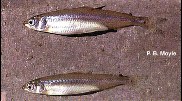
Épines dorsales (Total) : 0; Rayons mous dorsaux (Total) : 9 - 11; Épines anales: 0; Rayons mous anaux: 16 - 20; Vertèbres: 52 - 57. Vomer without posterior process; periphery of glossohyal bone with single row of conical teeth, central part toothless; pyloric caeca 4(2-5); base of adipose fin more than 20% of head length; eye large; adipose eyelid poorly developed.
Adults occur in open brackish and freshwater of large channels. Diet consists of zooplankton (Ref. 33312).
Cycle de vie et comportement reproducteur
Maturité | Reproduction | Frai | Œufs | Fécondité | Larves
Eggs are demersal (Ref. 33312).
Saruwatari, T., J.A. López and T.W. Pietsch, 1997. A revision of the ormerid genus Hypomesus Gill (Teleostei: Salmoniformes), with a description of a new species from the southern Kuril Islands. Species Diversity 2:59-82. (Ref. 33312)
Statut dans la liste rouge de l'IUCN (Ref. 130435: Version 2025-2 (Global))
Menace pour l'homme
Harmless
Utilisations par l'homme
Outils
Articles particuliers
Télécharger en XML
Sources Internet
Estimations basées sur des modèles
Indice de diversité phylogénétique (Réf.
82804): PD
50 = 0.5313 [Uniqueness, from 0.5 = low to 2.0 = high].
Bayesian length-weight: a=0.00363 (0.00177 - 0.00744), b=3.17 (2.99 - 3.35), in cm total length, based on LWR estimates for this (Sub)family-body shape (Ref.
93245).
Niveau trophique (Réf.
69278): 3.2 ±0.1 se; based on diet studies.
Résilience (Réf.
120179): Haut, temps minimum de doublement de population inférieur à 15 mois (tm=1; tmax=1).
Vulnérabilité de la pêche (Ref.
59153): Low vulnerability (10 of 100).
🛈