分類 / 名前
共通名の | 類義語 | Catalog of Fishes(部類, 種) | ITIS | CoL | WoRMS | Cloffa
>
Salmoniformes (Salmons) >
Salmonidae (Salmonids) > Coregoninae
Etymology: Stenodus: Greek, stenos = narrow + Greek, odous = teeth (Ref. 45335); leucichthys: leucichthys meaning white fish (Ref. 1998).
Taxonomic Remarks
Stenodus nelma (Pallas, 1773) is a valid species according to Kottelat and Freyhof (2007: Ref. 82592). The corresponding species summary page will be created in the future.
環境:環境 / 気候帯 / 深さの範囲 / 分布範囲
生態学
海; 新鮮な水; 汽水性の 底生の; 昇流魚 (Ref. 138280); 深さの範囲 10 - ? m (Ref. 4779). Boreal; 73°N - 58°N, 36°E - 111°W
North America: Arctic drainages from Anderson River in Northwest Territories, Canada to Kuskokwim River (Bering Sea tributary) in Alaska. Upstream in Mackenzie River and Yukon River drainages to British Columbia, Canada (Ref. 5723). Eurasia: Caspian Sea (common in central and southern Caspian in summer), Volga, Ural and Terak drainages (Ref. 59043). Hybridization with Coregonus nelsoni, Coregonus autumnalis and Coregonus muksun are due more to the broadcasting of eggs and sperm rather than pairing between species or genera (Ref. 27547).
初回成熟時の長さ / サイズ / 重さ / 年齢
成熟: Lm 72.5, range 70 - 75 cm
Max length : 150 cm TL オス/雌雄の選別がない; (Ref. 4574); common length : 61.0 cm TL オス/雌雄の選別がない; (Ref. 12193); 最大公表体重: 40.0 kg (Ref. 10318); 最大記録サイズ: 22 年 (Ref. 4576)
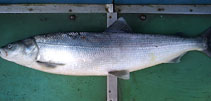
背面の脊椎 (合計) : 0; 背鰭 (合計) : 11 - 19; 肛門の骨: 0; 臀鰭: 14 - 19; 脊つい: 63 - 69. Distinguished by its large mouth, the protruding lower jaw, and the presence of only 13 to 17 gill rakers on the lower limb of the first gill arch (Ref. 27547). Dorsal fin high and pointed; pelvic fins with well developed axillary process (Ref. 27547). Generally silvery, with the back usually rather green, blue or pale brown; silvery white below; dorsal and caudal fins have dusky margins, other fins pale (Ref. 27547).
Body shape (shape guide): fusiform / normal.
Nerito-pelagic (Ref. 58426). Adults occur in coastal brackish waters near mouths of rivers, but usually in rivers or some land-locked lakes (Ref. 4779). At the sea, they are found throughout basin in pelagic zone with temperatures below 18° C and 20-50 m deep (Ref. 59043). Juveniles and adults overwinter and forage at the sea. Encountered in large lowland rivers during migration (Ref. 59043). Adults feed mostly on small fishes; young eat aquatic insect larvae and planktonic crustaceans (Ref. 4779). During spawning migration, it feeds little if at all (Ref. 27547). Mature individuals spawn on gravel shallows (Ref. 59043). Flesh is white, sweet and slightly oily (Ref. 27547). Sold fresh or frozen.
ライフサイクルと交尾行動
成熟 | 繁殖 | 放精 | 卵 | 生産力 | 幼生
Upstream migration from wintering areas begins at ice break-up. Early upstream movement may be associated with feeding, but movement soon becomes a definite migration to the spawning area. Spawning begins at dusk, and continuing well into the night. A female accompanied by a male, swims to the surface near the upstream end of the spawning ground. She rapidly moves across the current, extruding her eggs. The male, stays below the female so that as the eggs sink, sperm released, fertilizes the eggs. After completing a spawning pass, the female drifts downstream. She may repeat the spawning act over the downstream portion of the spawning area or may move upstream to the head of the grounds before releasing more eggs. Following spawning, there is a fairly rapid downstream migration to wintering grounds (Ref. 27547). It is not certain if spawning occurs annually or at longer intervals (Ref. 27547). Russian fish appear to spawn only every third or fourth year (Ref. 28219). Spawning frequency at Selawik, Alaska may be every other year (Ref. 27547).
Svetovidov, A.N., 1984. Salmonidae. p. 373-385. In P.J.P. Whitehead, M.-L. Bauchot, J.-C. Hureau, J. Nielsen and E. Tortonese (eds.) Fishes of the north-eastern Atlantic and the Mediterranean. UNESCO, Paris. vol. 1. (Ref. 4779)
IUCNのレッドリストの状況は (Ref. 130435: Version 2025-2 (Global))
人間の用途
水産業: 少数商業の; 水産養殖: 商業; ゲームフィッシュ: はい
用具
特記事項
XMLをダウンロードして下さい
インターネットの情報源
モデルに基づく推定値
系統多様性指数 (参照
82804): PD
50 = 0.7500 [Uniqueness, from 0.5 = low to 2.0 = high].
Bayesian length-weight: a=0.00479 (0.00394 - 0.00581), b=3.18 (3.13 - 3.23), in cm total length, based on LWR estimates for this species (Ref.
93245).
栄養段階 (参照
69278): 4.1 ±0.74 se; based on food items.
Generation time: 14.7 (8.1 - 19.6) years. Estimated as median ln(3)/K based on 10
growth studies.
回復力 (参照
120179): 低い, 4.5年~14年の倍増期間の最小個体群 (K=0.05-0.10; tm=5-12; tmax=22; Fec=80,000).
Prior r = 0.42, 95% CL = 0.28 - 0.63, Based on 2 data-limited stock assessments.
漁業の脆弱性 (Ref.
59153): High to very high vulnerability (74 of 100).
🛈
栄養素 (Ref.
124155): Calcium = 10.3 [5.6, 24.2] mg/100g; Iron = 0.409 [0.208, 0.798] mg/100g; Protein = 18.8 [17.2, 20.2] %; Omega3 = 0.565 [0.227, 1.537] g/100g; Selenium = 17.9 [7.4, 43.7] μg/100g; VitaminA = 8.75 [1.47, 53.62] μg/100g; Zinc = 0.304 [0.204, 0.438] mg/100g (wet weight); based on
nutrient studies.