>
Salmoniformes (Salmons) >
Salmonidae (Salmonids) > Salmoninae
Etymology: Salvelinus: Old name for char; it is the same root of german "saibling" = little salmon (Ref. 45335); malma: malma which is the the common name for this species in Kamchatka (Ref. 1998).
Eponymy: Dolly Varden is a character in Charles Dickens’ Barnaby Rudge (1841). [...] (Ref. 128868), visit book page.
More on author: Walbaum.
Milieu: milieu / Klimaatzone / Diepte / verspreidingsgebied
Ecologie
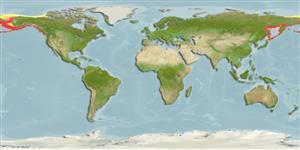
marien; zoet water; brak water benthopelagisch; anadroom (Ref. 138280); diepte 0 - 200 m (Ref. 50550). Temperate; 4°C - 18°C (Ref. 13614); 75°N - 38°N, 127°E - 123°W
North America: Arctic and Pacific drainages from lower Mackenzie River in Northwest Territories, Canada to Puget Sound and Quinault River in Washington, USA (Ref. 86798). Northwest Pacific: Korea to Bering Sea (Ref. 2850).
Lengte bij maturiteit / Grootte / Gewicht / Leeftijd
Maturiteit: Lm 23.5, range 12 - 21 cm
Max length : 127 cm TL mannelijk / geslacht onbekend; (Ref. 27436); common length : 37.5 cm TL mannelijk / geslacht onbekend; (Ref. 12193); max. gepubliceerd gewicht: 18.3 kg (Ref. 27436)
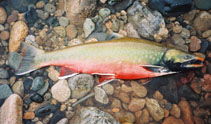
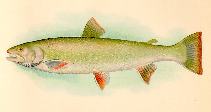
Dorsale stekels (totaal) : 0; Dorsale zachte stralen (totaal) : 10 - 16; Anale stekels: 0; Anale zachte stralen: 10 - 15. Body elongate, somewhat rounded, greatest body depth below dorsal fin. Head rather long. Pelvic fins with free-tipped fleshy appendage above its insertion. Caudal emarginate (Ref. 27547). Color varies with size, locality and habitat. Sea-run adults with back, upper head, and upper sides dark blue, the sides silvery to white. In freshwater populations, the back and upper sides are olive green to brown, the sides a paler color but bright red in spawning fish and at all times in some areas of Alaska, the underside white to dusky. The dorsal surface are marked with yellow, orange or red spots, more numerous and those along the lateral line smaller, than in arctic char. Spawning males, especially of anadromous populations, turn red on the ventral surface and tip of snout. The lower jaw, operculum and parts of the head are black, the back and sides turn olive-brown. The spots become more vivid orange-red, the pectoral and anal fins red-black with a white leading edge, the snout thickens and the lower jaw turns up. Females change less.
Body shape (shape guide): fusiform / normal; Cross section: compressed.
Adults occur in deep runs and pools of creeks and small to large rivers; also in lakes and the sea (Ref. 5723, 86798). They lives in very clean mountain streams (Ref. 12218). Nerito-pelagic (Ref. 58426). Typically anadromous, but many populations are landlocked. Anadromous fish may spend 2-3 years at sea, evidently near shore, migrate upstream usually in fall, and spawn during spring (Ref. 86798). Young remain in streams for 3-4 years and feed on insects, leeches, snails, and salmon eggs (Ref. 1998) before entering brackish and salt water to feed on insects, fishes, and other invertebrates. Utilized fresh and eaten fried, broiled, and baked (Ref. 9988).
Adults from the sea and lakes enter rivers to spawn. A female selects a nest site and begins to dig a redd while the male continues to court her and drive away intruding males. Upon completion of the redd, both drop into it and release eggs and sperm. This may be repeated several times before the eggs are covered by the female who swims along the edge of the of the redd, sweeping small pebbles and other particles into it with her tail and anal fin. Later, she may dig again and further cover the eggs while preparing a new nest (Ref. 27547). Breeding is an annual event for southern populations; occurring every second or third year in the Arctic (Ref. 27547). Males and females reportedly die after spawning (Ref. 12218).
Page, L.M. and B.M. Burr, 2011. A field guide to freshwater fishes of North America north of Mexico. Boston : Houghton Mifflin Harcourt, 663p. (Ref. 86798)
Status op de Rode Lijst van het IUCN (Ref. 130435: Version 2025-2 (Global))
Gevaar voor de mens
Harmless
Gebruik door de mens
Visserij: commercieel; sportvis: ja
Tools
Speciale rapporten
Download XML
Internetbronnen
Schattingen op basis van modellen
Gewenste temperatuur (Ref.
123201): 0.2 - 8, mean 2.2 °C (based on 653 cells).
Fylogenetische diversiteitsindex (Ref.
82804): PD
50 = 0.5000 [Uniqueness, from 0.5 = low to 2.0 = high].
Bayesian length-weight: a=0.00589 (0.00396 - 0.00875), b=3.04 (2.92 - 3.16), in cm total length, based on LWR estimates for this species & (Sub)family-body (Ref.
93245).
Trofisch niveau (Ref.
69278): 4.4 ±0.6 se; based on diet studies.
Weerstandsvermogen (Ref.
120179): laag, minimale populatieverdubbelingstijd 4,5-14 jaar (tm=3-5).
Prior r = 0.24, 95% CL = 0.16 - 0.36, Based on 1 data-limited stock assessment.
Kwetsbaarheid van de visserij (Ref.
59153): High to very high vulnerability (70 of 100).
🛈
Voedingsstoffen (Ref.
124155): Calcium = 6.82 [4.19, 11.37] mg/100g; Iron = 0.282 [0.177, 0.452] mg/100g; Protein = 18.1 [16.8, 19.6] %; Omega3 = 1.08 [0.46, 2.78] g/100g; Selenium = 13.9 [4.8, 42.4] μg/100g; VitaminA = 22.3 [7.0, 74.9] μg/100g; Zinc = 0.523 [0.395, 0.693] mg/100g (wet weight);