>
Cypriniformes (Carps) >
Nemacheilidae (Brook loaches)
Etymology: Schistura: Greek, schizein = to divide + Greek, oura = tail; an allusion to forked caudal fins (Ref. 45335); kengtungensis: Named for Keng Tung, a town close to the type locality.
More on author: Fowler.
Environnement : milieu / zone climatique / profondeur / gamme de distribution
Écologie
; eau douce benthopélagique. Tropical
Asia: Myanmar to the Khorat Plateau in the Mekong basin (Ref. 12693). Known from Salween and Chao Phraya basins (Ref. 26336).
Taille / Poids / Âge
Maturité: Lm ? range ? - ? cm
Max length : 11.0 cm SL mâle / non sexé; (Ref. 12693)
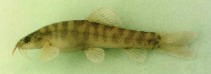
Rayons mous dorsaux (Total) : 12; Rayons mous anaux: 8. A member of the group of species with complete or nearly complete lateral line, 8 1/2 branched dorsal rays, 9+8 branched caudal rays and no sexual dimorphism. Can be distinguished by the following characters: caudal peduncle 1.10-1.44 times longer than deep, its length being 14.2-17.5% SL, 67-86% HL and its depth 11.5-13.2%SL, 52-62% HL; 8-11 bars; black basal caudal bar not reaching dorsal and ventral midlines, moderate keels on caudal peduncle, a median interruption in lower lip. Caudal fin emarginate (Ref. 39226). With slight depression at nape; 8-12 bars that turn into blotches on lateral line and saddle-markings dorsally; scales lacking on belly and on back between head and dorsal fin (Ref. 12693). Dorsal fin base with a black spot anteriorly, followed by an orange patch and a low elongate grey blotch (Ref. 43281).
Body shape (shape guide): elongated.
Inhabit small, shallow, high gradient streams with cobble or boulder substrates (Ref. 12693). A ripe female measuring 5.27 cm SL with ovulae 2.4 mm in diameter (Ref. 39226).
Cycle de vie et comportement reproducteur
Maturité | Reproduction | Frai | Œufs | Fécondité | Larves
Rainboth, W.J., 1996. Fishes of the Cambodian Mekong. FAO species identification field guide for fishery purposes. FAO, Rome, 265 p. (Ref. 12693)
Statut dans la liste rouge de l'IUCN (Ref. 130435: Version 2025-2 (Global))
Menace pour l'homme
Harmless
Utilisations par l'homme
Outils
Articles particuliers
Télécharger en XML
Sources Internet
Estimations basées sur des modèles
Indice de diversité phylogénétique (Réf.
82804): PD
50 = 0.5000 [Uniqueness, from 0.5 = low to 2.0 = high].
Bayesian length-weight: a=0.00708 (0.00323 - 0.01553), b=3.03 (2.86 - 3.20), in cm total length, based on LWR estimates for this Genus-body shape (Ref.
93245).
Niveau trophique (Réf.
69278): 3.0 ±0.3 se; based on size and trophs of closest relatives
Résilience (Réf.
120179): Milieu, temps minimum de doublement de population : 1,4 à 4,4 années (Preliminary K or Fecundity.).
Vulnérabilité de la pêche (Ref.
59153): Low vulnerability (10 of 100).
🛈