Environnement : milieu / zone climatique / profondeur / gamme de distribution
Écologie
; eau douce démersal. Tropical
Asia: China, Viet Nam, Cambodia. Known from the Mekong basin.
Taille / Poids / Âge
Maturité: Lm ? range ? - ? cm
Max length : 5.7 cm SL mâle / non sexé; (Ref. 40433)
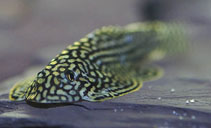
Rayons mous dorsaux (Total) : 12; Épines anales: 1; Rayons mous anaux: 4; Vertèbres: 31 - 32. Sides of body with 3-5 bold longitudinal stripes. Pectoral fin with bold submarginal stripe, otherwise with reticulated marks. Pelvic fin with 3 bold stripes. Dorsal surface of head, body and paired fins otherwise with bold, connected polygonal markings or reticulations with dark outlines and pale centers. Pectoral fin branched rays 19-21. Pelvic fin branched rays 19 (Ref. 38650). Differs from other species by the following combination of characters: posterior part of paired fins with 1-2 bold concentric bands; pelvic-fin origin below dorsal-fin origin; pectoral-fin origin behind corner of mouth; pelvic fin reaching anal-fin origin; no cavity around mouth; small soft elevated patches of fine tubercles on first pectoral-fin rays in males, tubercles on simple pectoral-fin ray not enlarged; no cavity around mouth; no skin-fold between oropectoral membrane and ventral surface of head; and 38-49 lateral line scales (Ref. 40433).
Body shape (shape guide): elongated.
Rheophilous, inhabits rapids and riffles. Found in small streams with large and deep pools covered by submerged plants, provided that small riffles are present between these pools. Occurs also in high gradient streams consisting almost exclusively of waterfalls; in larger rivers, at the upper extremity of riffles where current velocity do not exceed 0.2 m/sec, as well as habitats with high water velocities exceeding 1 m/sec. Often associated with Annamia normani, Balitora sp., Schistura spp., Glyptothorax spp., Anguilla marmorata, and Rhinogobius spp. Stomach contents include benthic invertebrates and algae. Observed to be active during daytime searching in the periphyton on both horizontal and vertical surfaces of stones probably searching for aquatic invertebrates (Ref. 40433). Commonly found in aquarium trade in Finland (Länsman, pers. comm., 25/03/2010, Ref. to find).
Cycle de vie et comportement reproducteur
Maturité | Reproduction | Frai | Œufs | Fécondité | Larves
Freyhof, J. and D.V. Serov, 2000. Review of the genus Sewellia with description of two new species from Vietnam (Cypriniformes: Balitoridae). Ichthyol. Explor. Freshwat. 11(3):217-240. (Ref. 40433)
Statut dans la liste rouge de l'IUCN (Ref. 130435: Version 2025-2 (Global))
Menace pour l'homme
Harmless
Utilisations par l'homme
Pêcheries: commercial; Aquarium: Commercial
Outils
Articles particuliers
Télécharger en XML
Sources Internet
Estimations basées sur des modèles
Indice de diversité phylogénétique (Réf.
82804): PD
50 = 0.5001 [Uniqueness, from 0.5 = low to 2.0 = high].
Bayesian length-weight: a=0.00646 (0.00285 - 0.01461), b=3.11 (2.91 - 3.31), in cm total length, based on LWR estimates for this (Sub)family-body shape (Ref.
93245).
Niveau trophique (Réf.
69278): 2.7 ±0.24 se; based on food items.
Vulnérabilité de la pêche (Ref.
59153): Low vulnerability (10 of 100).
🛈