>
Salmoniformes (Salmons) >
Salmonidae (Salmonids) > Coregoninae
Etymology: Prosopium: Greek, prosopon = face (Ref. 45335); cylindraceum: cylindraceum meaning like a cylinder (Ref. 1998).
Milieu: milieu / Klimaatzone / Diepte / verspreidingsgebied
Ecologie
; zoet water; brak water benthopelagisch; potamodroom (Ref. 126106); diepte 4 - 72 m (Ref. 1998), usually ? - 37 m (Ref. 1998). Temperate; 2°C - 18°C (Ref. 1998); 72°N - 41°N, 103°E - 56°W (Ref. 86798)
North America: Arctic and Pacific drainages from western Hudson Bay in Canada to Alaska and northern British Columbia, Canada; Arctic and Atlantic drainages from Quebec and Ontario in Canada to Connecticut in USA; St. Lawrence-Great Lakes basin in Canada-USA (except Lake Erie). Northern Asia: widely distributed in Siberian rivers (Ref. 26334).
Lengte bij maturiteit / Grootte / Gewicht / Leeftijd
Maturiteit: Lm 30.0 range ? - ? cm
Max length : 59.0 cm TL mannelijk / geslacht onbekend; (Ref. 40637); common length : 28.6 cm TL mannelijk / geslacht onbekend; (Ref. 12193); max. gepubliceerd gewicht: 2.7 kg (Ref. 4699); max. gerapporteerde leeftijd: 16 Jaren (Ref. 28860)
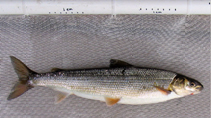
Dorsale stekels (totaal) : 0; Dorsale zachte stralen (totaal) : 11 - 15; Anale stekels: 0; Anale zachte stralen: 10 - 13. Body slender, elongate, almost cylindrical in cross section, posteriorly somewhat compressed laterally, greatest depth in front of the dorsal fin. Head relatively short; eye moderate, its diameter less than snout length; snout pointed, "pinched" or compressed laterally, rounded in lateral view, a single flap of skin present between the nostrils; mouth small, ventral in position, overhung by snout; maxillaries extending posteriorly almost to anterior margin or eye in adults. This species has more color than most coregonids. Overall coloration of adults almost silvery, silvery white below. Scales specially on back, with well-defined, dark pigmented borders, making them conspicuous. Pectoral fins are amber in color, slight amber tint also to pelvic and anal fins. Pectoral fins take on an orange tint during spawning, the pelvic and anal fins also to a lesser extent. the adipose fin is usually brown spotted, particularly in specimens from central and eastern Canada. Two or more longitudinal rows of black spots are present on the sides of young specimen.
Body shape (shape guide): fusiform / normal; Cross section: oval.
Adults inhabit shallow areas of lakes and clear streams and rarely enters brackish water (Ref. 5723, 86798). Also in rivers with swift current and stony bottom. Migration is limited to movements associated with spawning (Ref. 27547). Epipelagic (Ref. 58426). Adults feed on benthic invertebrates and occasionally on fishes (Ref. 1998) and fish eggs (Ref. 593). One specimen taken from a depth of 218.9 m in eastern Lake Superior, off Grand Marais, Michigan (Ref. 1998).
There are inshore and upstream movements (Ref. 28863) that may be related to spawning (Ref. 27547). Swims in pairs during spawning (Ref. 28858). Also Ref. 28803.
Page, L.M. and B.M. Burr, 2011. A field guide to freshwater fishes of North America north of Mexico. Boston : Houghton Mifflin Harcourt, 663p. (Ref. 86798)
Status op de Rode Lijst van het IUCN (Ref. 130435: Version 2025-2 (Global))
Gevaar voor de mens
Harmless
Gebruik door de mens
Visserij: van minder commercieel belang; sportvis: ja
Tools
Speciale rapporten
Download XML
Internetbronnen
Schattingen op basis van modellen
Fylogenetische diversiteitsindex (Ref.
82804): PD
50 = 0.5156 [Uniqueness, from 0.5 = low to 2.0 = high].
Bayesian length-weight: a=0.00525 (0.00322 - 0.00854), b=3.23 (3.09 - 3.37), in cm total length, based on LWR estimates for this species & (Sub)family-body (Ref.
93245).
Trofisch niveau (Ref.
69278): 3.3 ±0.41 se; based on food items.
Generation time: 5.4 (3.4 - 9.4) years. Estimated as median ln(3)/K based on 11
growth studies.
Weerstandsvermogen (Ref.
120179): laag, minimale populatieverdubbelingstijd 4,5-14 jaar (tm=5-7; tmax=16; Fec=1,000).
Kwetsbaarheid van de visserij (Ref.
59153): Moderate to high vulnerability (51 of 100).
🛈