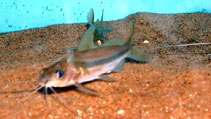
Mystus atrifasciatus : fisheries

You can sponsor this page

Mystus atrifasciatus Fowler, 1937

Carica il tuo foto e Video
Immagini | Google image
Image of Mystus atrifasciatus
Mystus atrifasciatus
Immagine di James, A.

Classificazione / Nomi Nomi Comuni | Sinonimi | Catalog of Fishes(Genere, Specie) | ITIS | CoL | WoRMS | Cloffa

> Siluriformes (Catfishes) > Bagridae (Bagrid catfishes)
Etymology: Mystus: Greek, mystax = whiskered, used by Belon in 1553 to describe all fishes with whiskers (Ref. 45335).
More on author: Fowler.

Ambiente: milieu / zona climatica / distribuzione batimetrica / gamma di distribuzione Ecologia

; acqua dolce demersale. Tropical

Distribuzione Territories | Aree FAO | Ecosistemi | Presenze | Mappa dei ritrovamenti | Introduzioni | Faunafri

Asia: Mekong, Chao Phraya and Meklong basins.

Dimensione / Peso / Età

Maturità: Lm ?  range ? - ? cm
Max length : 15.0 cm SL maschio/sesso non determinato; (Ref. 30857)

Breve descrizione Chiavi di identificazione | Morfologia | Morfometria

Vertebre: 36 - 39. Has 3 faint dark and 2 whitish stripes on the sides; adipose fin longer than anal fin and almost contiguous with the dorsal fin; eyes not visible when head is viewed from below (Ref. 27732). Cranial fontanel extends posteriorly to about midway between posterior rim of eye and supraoccipital process (Ref. 12693).
Body shape (shape guide): elongated.

Biologia     Glossario (es. epibenthic)

Facultative air-breathing in the genus (Ref. 126274); Adults inhabit rivers, streams and reservoirs. Feed mainly on crustaceans and zooplankton along with small bits of algae and fish scales. May forage in schools like the other small striped species of Mystus. Move into floodplains during periods of high water and is often found in places with submerged woody vegetation. Oviparous, distinct pairing possibly like other members of the same family (Ref. 205). Usually marketed fresh and may also be sold smoked (Ref. 12693).

Ciclo vitale e comportamento di accoppiamento Maturità | Riproduzione | Deposizione | Uova | Fecondità | Larve

Riferimento principale Caricare le referenze | Bibliografia | Coordinatore | Collaboratori

Rainboth, W.J., 1996. Fishes of the Cambodian Mekong. FAO species identification field guide for fishery purposes. FAO, Rome, 265 p. (Ref. 12693)

Stato della Lista Rossa IUCN (Ref. 130435: Version 2025-2 (Global))

  Least Concern (LC) ; Date assessed: 20 February 2011

CITES

Not Evaluated

CMS (Ref. 116361)

Not Evaluated

Minaccia per l'uomo

  Harmless


Usi umani

Pesca: commerciale
FAO - Publication: search | FishSource |

Informazioni ulteriori

Ecologia trofica
Articoli alimentari (prede)
Alimentazione
Consumo di cibo
Razioni alimentari
Predatori
Ecologia
Ecologia
Dinamica della popolazione
Parametri di crescita
Età massima / dimensioni massime
Rapporto lunghezza-peso.
Lunghezza-lunghezza rel.
Lunghezza-frequenze
Conversione di massa
Reclutamento
Abbondanza
Ciclo di vita
Riproduzione
Maturità
Maturità/Gli occhielli sono relativi.
Fecondità
Deposizione
Aggregazioni riproduttive
Uova
Sviluppo delle uova
Larve
Dinamica popolazioni larvali
Distribuzione
Territories
Aree FAO
Ecosistemi
Presenze
Introduzioni
BRUVS - Video
Anatomia
Area branchiale
Cervello
Otolite
Fisiologia
Composizione corporea
Nutrienti
Consumo di ossigeno
Tipo di nuoto
Velocità di nuoto
Pigmenti visivi
Suono del pesce
Malattie e parassiti
Tossicità (LC50)
Genetica
Genome
Genetica
Eterozigosi
Ereditarietà
Diversità genetica
Legato all'uomo
Sistemi di acquacoltura
Profili di acquacoltura
Varietà
Casi di Ciguatera
Francobolli, monete, materiale vario.
Raggiungimento
Collaboratori
Bibliografia
Bibliografia

Strumenti

Rapporti speciali

Scarica XML

Fonti Internet

AFORO (otoliths) | Aquatic Commons | BHL | Cloffa | Websites from users | Check FishWatcher | CISTI | Catalog of Fishes: Genere, Specie | DiscoverLife | ECOTOX | FAO - Publication: search | Faunafri | Fishipedia | Fishtrace | GloBI | Google Books | Google Scholar | Google | IGFA World Record | OneZoom | Open Tree of Life | Otolith Atlas of Taiwan Fishes | PubMed | Reef Life Survey | Socotra Atlas | TreeBase | Tree of Life | Wikipedia: Go, ricerca | World Records Freshwater Fishing | Zoobank | Record zoologico

Stime basate su modelli

Indice di diversità filogenetica (Fonte Biblio. 82804):  PD50 = 0.5000   [Uniqueness, from 0.5 = low to 2.0 = high].
Bayesian length-weight: a=0.00891 (0.00457 - 0.01738), b=3.00 (2.84 - 3.16), in cm total length, based on LWR estimates for this species & Genus-body shape (Ref. 93245).
Livello trofico (Fonte Biblio. 69278):  3.0   ±0.45 se; based on food items.
Resilienza (Fonte Biblio. 120179):  Medio, tempo minimo di raddoppiamento della popolazione 1.4 - 4.4 anni (Assuming Fec < 10,000).
Vulnerabilità della pesca (Ref. 59153):  Low vulnerability (10 of 100). 🛈
Categoria di prezzo (Ref. 80766):   Unknown.