>
Ovalentaria/misc (Various families in series Ovalentaria) >
Pomacentridae (Damselfishes) > Chrominae
Etymology: Chromis: Greek, chromis = a fish, perhaps a perch (Ref. 45335).
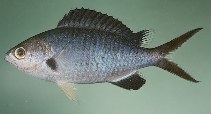
Eponymy: Pamela J McCosker is the wife of the second author. She was compared with the fish, which was described as a “…slender specimen of comparable beauty.” (Ref. 128868), visit book page.
More on authors: Randall & McCosker.
Ambiente: milieu / zona climatica / distribuzione batimetrica / gamma di distribuzione
Ecologia
marino associati a barriera corallina; distribuzione batimetrica 4 - 44 m (Ref. 10668). Tropical; 23°S - 25°S
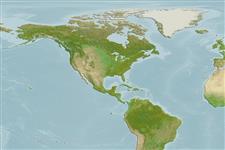
Eastern Central Pacific: Pitcairn, Tuamoto Islands, and Austral Islands.
Dimensione / Peso / Età
Maturità: Lm ? range ? - ? cm
Max length : 10.4 cm SL maschio/sesso non determinato; (Ref. 10668)
Breve descrizione
Chiavi di identificazione | Morfologia | Morfometria
Spine dorsali (totale) : 15; Raggi dorsali molli (totale) : 10 - 11; Spine anali: 2; Raggi anali molli: 10 - 12; Vertebre: 26.
Adults feed on zooplankton well above the substratum. They swim swiftly for cover from predators. The fleshy papillae at the posterior and ventral edge of the orbit may function to ensure smooth flow of water over the eye when swimming rapidly (Ref. 10668). Feeds on zooplanktons (Ref. 89972). Oviparous, distinct pairing during breeding (Ref. 205). Eggs are demersal and adhere to the substrate (Ref. 205). Males guard and aerate the eggs (Ref. 205). Diurnal species (Ref. 54980).
Ciclo vitale e comportamento di accoppiamento
Maturità | Riproduzione | Deposizione | Uova | Fecondità | Larve
Oviparous, distinct pairing during breeding (Ref. 205). Eggs are demersal and adhere to the substrate (Ref. 205). Males guard and aerate the eggs (Ref. 205).
Randall, J.E. and J.E. McCosker, 1992. Two new damselfishes of the genus Chromis (Perciformes: Pomacentridae) from the South Pacific. Proc. Calif. Acad. Sci. 47(12):329-337. (Ref. 10668)
Stato della Lista Rossa IUCN (Ref. 130435: Version 2025-2 (Global))
Minaccia per l'uomo
Harmless
Usi umani
Strumenti
Rapporti speciali
Scarica XML
Fonti Internet
Stime basate su modelli
Temperatura preferita (Fonte Biblio.
123201): 24.2 - 25, mean 24.6 °C (based on 7 cells).
Indice di diversità filogenetica (Fonte Biblio.
82804): PD
50 = 0.5000 [Uniqueness, from 0.5 = low to 2.0 = high].
Bayesian length-weight: a=0.01259 (0.00569 - 0.02786), b=3.03 (2.84 - 3.22), in cm total length, based on LWR estimates for this (Sub)family-body shape (Ref.
93245).
Livello trofico (Fonte Biblio.
69278): 3.4 ±0.45 se; based on food items.
Resilienza (Fonte Biblio.
120179): Alto, tempo minimo di raddoppiamento della popolazione meno di 15 mesi (Preliminary K or Fecundity.).
Vulnerabilità della pesca (Ref.
59153): Low vulnerability (10 of 100).
🛈
Nutrienti (Ref.
124155): Calcium = 105 [62, 185] mg/100g; Iron = 0.854 [0.540, 1.349] mg/100g; Protein = 18.6 [17.6, 19.6] %; Omega3 = 0.165 [0.101, 0.267] g/100g; Selenium = 22.2 [12.3, 42.5] μg/100g; VitaminA = 255 [90, 693] μg/100g; Zinc = 1.7 [1.2, 2.4] mg/100g (wet weight);