>
Salmoniformes (Salmons) >
Salmonidae (Salmonids) > Coregoninae
Etymology: Coregonus: Greek, kore = pupils of the eye + Greek, gonia = angle (Ref. 45335).
More on author: Pallas.
Entorno: milieu / zona climática / rango de profundidad / gama de distribución
Ecología
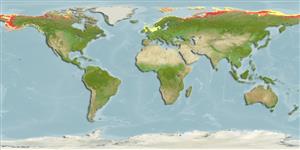
marino; agua dulce; salobre pelagic-neritic; anadromo (Ref. 138280). Polar; 84°N - 49°N, 8°W - 95°W
Europe: All drainages (except Ob and Baikal) of Arctic Ocean in Eurasia from Mezen eastward. North America: Cape Barrow to Coronation Bay. Introduced in many localities of former USSR, but not established (Ref. 59043).
Longitud en la primera madurez / Tamaño / Peso / Edad
Madurez: Lm ? range ? - ? cm
Max length : 65.0 cm SL macho / no sexado; (Ref. 59043); common length : 47.0 cm TL macho / no sexado; (Ref. 12193); edad máxima reportada: 12 años (Ref. 59043)
Descripción breve
Claves de identificación | Morfología | Morfometría
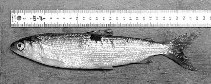
Espinas dorsales (total) : 0; Radios blandos dorsales (total) : 10 - 12; Espinas anales: 0; Radios blandos anales: 12 - 14; Vértebra: 64 - 67. Distinguished by the pale or colorless pelvic fins, a terminal mouth and the presence of 41 to 48 gill rakers on the 1st gill arch (Ref. 27547). Dorsal fairly high and slightly falcate; pelvic with axillary process (Ref. 27547). Brown to dark greenish above fading to silvery on sides and belly; fins pale (Ref. 27547).
Body shape (shape guide): fusiform / normal.
Adults occur in brackish waters (20-22 ppt) of coastal lagoons and mouths of rivers and bays (Ref. 4779, 59043). Nerito-pelagic (Ref. 58426). Food consists of small crustaceans, insects, small fishes (Ref. 28219, 28857), worms and clams (Ref. 58426, 59043). No feeding occurs during the upstream migration (Ref. 4779). Lives 10 -12 years, rarely up to 20 (Ref. 59043). Mature individuals enter rivers in shoals to spawn (Ref. 4779). They spend 6-8 years at sea before maturing and returning to rivers in June - July, to spawn in September - October of same year. A second run in autumn; those fishes remain a year in rivers before spawning. They move far upstream, sometimes up to 1500 km, spawn in shallow tributaries with some current in well oxygenated water over gravel bottom. Individual females do not spawn every year; only 2-3 times during entire life. After spawning adults return directly to sea. Embryonic development lasts up to 7 months. Alevins migrate downstream in May - June (Ref. 59043). Collected by fyke nets (Ref. 4526). An important commercial species but catches and abundance are markedly reduced in recent years (Ref. 59043).
Mature adults migrate upstream in the summer and may cover as much as 1,000 km (Ref. 28219) to spawn over gravel in fairly swift water. After spawning, adults return downstream. Young probably hatch in the spring and descend rivers into estuaries (Ref. 27547). Coregonus autumnalis do not breed yearly (Ref. 28219, 28220).
Wheeler, A., 1992. A list of the common and scientific names of fishes of the British Isles. J. Fish Biol. 41(suppl.A):1-37. (Ref. 5204)
Situación en la Lista Roja de la UICN (Ref. 130435: Version 2025-2 (Global))
Amenaza para el ser humano
Harmless
Usos humanos
Pesquerías: comercial
Herramientas
Informes especiales
Descargar XML
Fuentes de Internet
Estimaciones basadas en modelos
Temperatura preferida (Referencia
123201): -1.7 - 3.4, mean -0.4 °C (based on 988 cells).
Índice de diversidad filogenética (Referencia
82804): PD
50 = 0.5000 [Uniqueness, from 0.5 = low to 2.0 = high].
Bayesian length-weight: a=0.00468 (0.00404 - 0.00541), b=3.22 (3.18 - 3.26), in cm total length, based on LWR estimates for this species (Ref.
93245).
Nivel trófico (Referencia
69278): 3.7 ±0.2 se; based on diet studies.
Resiliencia (Referencia
120179): Bajo, población duplicada en un tiempo mínimo de 4.5-14 años (tm=6; Fec=2,000).
Prior r = 0.40, 95% CL = 0.26 - 0.60, Based on 1 data-limited stock assessment.
Vulnerabilidad pesquera (Ref.
59153): Moderate to high vulnerability (52 of 100).
🛈
Nutrientes (Ref.
124155): Calcium = 16.1 [7.0, 29.2] mg/100g; Iron = 0.468 [0.222, 0.892] mg/100g; Protein = 18.3 [17.2, 19.5] %; Omega3 = 0.693 [0.272, 1.906] g/100g; Selenium = 11.8 [4.4, 30.8] μg/100g; VitaminA = 6.52 [1.07, 40.50] μg/100g; Zinc = 0.432 [0.329, 0.617] mg/100g (wet weight); based on
nutrient studies.