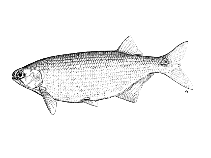
Hiodon alosoides, Goldeye : fisheries, gamefish

You can sponsor this page

Hiodon alosoides (Rafinesque, 1819)

Goldeye
Carica il tuo foto e Video
Immagini | Google image
Image of Hiodon alosoides (Goldeye)
Hiodon alosoides
Immagine di McPhail, J.D.

Classificazione / Nomi Nomi Comuni | Sinonimi | Catalog of Fishes(Genere, Specie) | ITIS | CoL | WoRMS | Cloffa

> Hiodontiformes (Mooneyes) > Hiodontidae (Mooneyes)
Etymology: Hiodon: From Greek letter "gamma, "y", due to the shape of the teeth; Greek, odous = teeth; bone forming the base of the tongue (Ref. 45335)alosoides: alosoides --- shadlike, referring to its general shape and similarity to Alosa, Clupeidae (Ref. 1998).
More on author: Rafinesque.

Ambiente: milieu / zona climatica / distribuzione batimetrica / gamma di distribuzione Ecologia

; acqua dolce pelagico; potamodromo (Ref. 126106). Temperate; 69°N - 31°N

Distribuzione Territories | Aree FAO | Ecosistemi | Presenze | Mappa dei ritrovamenti | Introduzioni | Faunafri

North America: western Ontario to the Mackenzie River as far down as Aklavik. In the east, it extends southwest below the Great Lakes, through the Ohio and Mississippi River drainages. In the, west it occurs southeast from western Alberta, through eastern Montana and Wyoming, to Oklahoma.

Dimensione / Peso / Età

Maturità: Lm ?  range ? - ? cm
Max length : 52.0 cm FL maschio/sesso non determinato; (Ref. 40637); common length : 31.0 cm OT maschio/sesso non determinato; (Ref. 3221); peso massimo pubblicato: 1.7 kg (Ref. 4699); Età massima riportata: 14 anni (Ref. 12193)

Breve descrizione Chiavi di identificazione | Morfologia | Morfometria


Body shape (shape guide): fusiform / normal.

Biologia     Glossario (es. epibenthic)

Adults occur in deep, open pools and channels of turbid, lowland rivers; small lakes and impoundments (Ref. 5723, 10294). They feed on surface and aquatic insects, crustaceans, mollusks, small fishes, frogs, shrew, and mice (Ref. 10294). Mature individuals migrate upstream in the spring to spawn and feed. Moves downstream in the fall. Mainly nocturnal. Preyed upon by birds, some mammals, and other fishes. Marketed smoked.

Ciclo vitale e comportamento di accoppiamento Maturità | Riproduzione | Deposizione | Uova | Fecondità | Larve

Riferimento principale Caricare le referenze | Bibliografia | Coordinatore | Collaboratori

Scott, W.B. and E.J. Crossman, 1973. Freshwater fishes of Canada. Bull. Fish. Res. Board Can. 184: xi+1-966. (Ref. 1998)

Stato della Lista Rossa IUCN (Ref. 130435: Version 2025-2 (Global))

  Least Concern (LC) ; Date assessed: 14 February 2012

CITES

Not Evaluated

CMS (Ref. 116361)

Not Evaluated

Minaccia per l'uomo

  Harmless


Usi umani

Pesca: scarso interesse commerciale; Pesce da pesca sportiva: si
FAO - Publication: search | FishSource |

Informazioni ulteriori

Ecologia trofica
Articoli alimentari (prede)
Alimentazione
Consumo di cibo
Razioni alimentari
Predatori
Ecologia
Ecologia
Dinamica della popolazione
Parametri di crescita
Età massima / dimensioni massime
Rapporto lunghezza-peso.
Lunghezza-lunghezza rel.
Lunghezza-frequenze
Conversione di massa
Reclutamento
Abbondanza
Ciclo di vita
Riproduzione
Maturità
Maturità/Gli occhielli sono relativi.
Fecondità
Deposizione
Aggregazioni riproduttive
Uova
Sviluppo delle uova
Larve
Dinamica popolazioni larvali
Distribuzione
Territories
Aree FAO
Ecosistemi
Presenze
Introduzioni
BRUVS - Video
Anatomia
Area branchiale
Cervello
Otolite
Fisiologia
Composizione corporea
Nutrienti
Consumo di ossigeno
Tipo di nuoto
Velocità di nuoto
Pigmenti visivi
Suono del pesce
Malattie e parassiti
Tossicità (LC50)
Genetica
Genome
Genetica
Eterozigosi
Ereditarietà
Diversità genetica
Legato all'uomo
Sistemi di acquacoltura
Profili di acquacoltura
Varietà
Casi di Ciguatera
Francobolli, monete, materiale vario.
Raggiungimento
Collaboratori
Bibliografia
Bibliografia

Strumenti

Rapporti speciali

Scarica XML

Fonti Internet

AFORO (otoliths) | Alien/Invasive Species database | Aquatic Commons | BHL | Cloffa | Websites from users | Check FishWatcher | CISTI | Catalog of Fishes: Genere, Specie | DiscoverLife | ECOTOX | FAO - Publication: search | Faunafri | Fishipedia | Fishtrace | GloBI | Google Books | Google Scholar | Google | IGFA World Record | OneZoom | Open Tree of Life | Otolith Atlas of Taiwan Fishes | PubMed | Reef Life Survey | Socotra Atlas | TreeBase | Tree of Life | Wikipedia: Go, ricerca | World Records Freshwater Fishing | Record zoologico

Stime basate su modelli

Indice di diversità filogenetica (Fonte Biblio. 82804):  PD50 = 1.2500   [Uniqueness, from 0.5 = low to 2.0 = high].
Bayesian length-weight: a=0.00832 (0.00454 - 0.01523), b=3.04 (2.87 - 3.21), in cm total length, based on LWR estimates for this species & (Sub)family-body (Ref. 93245).
Livello trofico (Fonte Biblio. 69278):  3.2   ±0.2 se; based on diet studies.
Generation time: 9.2 ( na - na) years. Estimated as median ln(3)/K based on 1 growth studies.
Resilienza (Fonte Biblio. 120179):  Medio, tempo minimo di raddoppiamento della popolazione 1.4 - 4.4 anni (Fec = 5,761).
Vulnerabilità della pesca (Ref. 59153):  High vulnerability (63 of 100). 🛈
Categoria di prezzo (Ref. 80766):   Unknown.