>
Notacanthiformes (Halosaurs and deep-sea spiny eels) >
Notacanthidae (Deep-sea spiny eels)
Etymology: Notacanthus: Greek, noton = back + Greek, akantha = thorn (Ref. 45335).
Eponymy: Johann Hieronymus Chemnitz (1730–1800) was a German naturalist, conchologist and theologian. [...] (Ref. 128868), visit book page.
More on author: Bloch.
Taxonomic Remarks
Species spelling Paxton et al. 1989 (Ref.7300:150).
Ambiente: milieu / zona climática / intervalo de profundidade / gama de distribuição
Ecologia
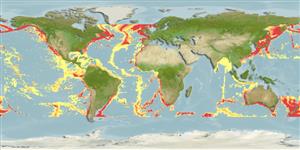
marinhas bentopelágico; intervalo de profundidade 125 - 3285 m (Ref. 58426), usually 128 - 1000 m (Ref. 117245). Deep-water; 61°N - 50°S, 180°W - 180°E
Western North Atlantic: from Labrador to the Gulf of Mexico; Eastern North Atlantic from Iceland and Norway to North Africa (Ref. 130977). Possible in the eastern Indian Ocean: Australia (Ref. 7300) and southwest Pacific: New Zealand (Ref. 5755).
Tamanho / Peso / Idade
Maturidade: Lm ? range ? - ? cm
Max length : 120 cm TL macho/indeterminado; (Ref. 4449)
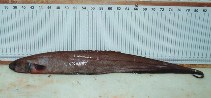
Espinhos dorsais (total) : 5 - 12; Raios dorsais moles (total) : 2; Espinhos anais: 14 - 17; Raios anais moles: 125 - 145; Vértebras: 225 - 239. Presence of palatine and dentary teeth in two or more rows. Numerous dorsal spines. Small specimens are pale tan or pale bluish gray, large specimens are dark brown (Ref. 37108).
Body shape (shape guide): elongated.
Benthopelagic (Ref. 58302) and epibenthic (Ref. 58426). Not uncommon in depths around 180 m off Iceland and Greenland. Individuals with nearly ripe eggs have been found in late autumn off Iceland. Mostly found at depths well below 200 m, but enters slightly shallower water on Grand Banks in Canada (Ref. 7251). Feeds primarily on sea anemones (Ref. 4449).
Ciclo de vida e comportamento de acasalamento
Maturidade | Reprodução | Desova | Ovos | Fecundidade | Larvas
Sulak, K.J., 1990. Notacanthidae. p. 133-135. In J.C. Quero, J.C. Hureau, C. Karrer, A. Post and L. Saldanha (eds.) Check-list of the fishes of the eastern tropical Atlantic (CLOFETA). JNICT, Lisbon; SEI, Paris; and UNESCO, Paris. Vol. 1. (Ref. 4449)
Categoria na Lista Vermelha da IUCN (Ref. 130435: Version 2025-2 (Global))
Ameaça para o homem
Harmless
Utilização humana
Pescarias: sem interesse
Ferramentas
Relatórios especiais
Descarregue XML
Fontes da internet
Estimativas baseadas em modelos
Temperatura preferida (Ref.
123201): 1 - 14.9, mean 6.1 °C (based on 2531 cells).
Índice de diversidade filogenética (Ref.
82804): PD
50 = 0.5040 [Uniqueness, from 0.5 = low to 2.0 = high].
Bayesian length-weight: a=0.00191 (0.00102 - 0.00357), b=3.07 (2.89 - 3.25), in cm total length, based on LWR estimates for this species & (Sub)family-body (Ref.
93245).
Nível Trófico (Ref.
69278): 3.5 ±0.37 se; based on food items.
Generation time: 27.5 ( na - na) years. Estimated as median ln(3)/K based on 2
growth studies.
Resiliência (Ref.
120179): Baixo, tempo mínimo de duplicação da população 4,5 - 14 anos (Assuming tmax>10).
Vulnerabilidade da pesca (Ref.
59153): High to very high vulnerability (69 of 100).
🛈
Nutrientes (Ref.
124155): Calcium = 9.83 [5.11, 21.37] mg/100g; Iron = 0.259 [0.129, 0.528] mg/100g; Protein = 16.1 [14.9, 17.3] %; Omega3 = 0.274 [0.129, 0.578] g/100g; Selenium = 39.1 [14.6, 106.8] μg/100g; VitaminA = 9.64 [1.93, 48.64] μg/100g; Zinc = 0.376 [0.235, 0.610] mg/100g (wet weight);