>
Anguilliformes (Eels and morays) >
Nemichthyidae (Snipe eels)
Etymology: Nemichthys: Greek, nema, -atos = filament + Greek, ichthys = fish (Ref. 45335); scolopaceus: From the Latin 'scolopax' referring to the long bill-like jaws (Ref. 6885).
More on author: Richardson.
पर्यावरण: पर्यावरण / जलवायु क्षेत्र / गहराई सीमा / वितरण सीमा
पारिस्थितिकी
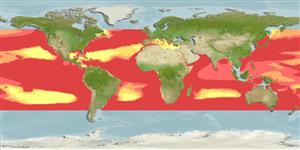
समुद्री बैथीपिलाजिक; गहराई सीमा 0 - 4337 m (Ref. 96339), usually 100 - 1000 m (Ref. 58302). Deep-water; 55°N - 42°S, 180°W - 180°E
Worldwide in tropical and temperate seas. Western Atlantic: Nova Scotia, Canada and northern Gulf of Mexico to Brazil. Eastern Atlantic: Spain to South Africa, including western Mediterranean (Ref. 3247); reported from Iceland (Ref. 12462). Regularly found in the Skagerrak (Ref. 35387). Northwest Pacific: Japan (Ref. 6885) and Arafura Sea (Ref. 9819). Eastern Pacific: Alaska (Ref. 6885) to Chile (Ref. 9068), including the Gulf of California (Ref. 32364).
आकार / वज़न / आयु
परिपक्व अवधि: Lm ? range ? - ? cm
Max length : 130 cm TL पुल्लिंग / अलिंग; (Ref. 35388)
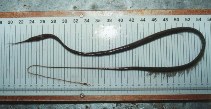
पृष्ठीय रीढ़ (सम्पूर्ण) : 0; गुदा कांटा: 0. Jaws long (Ref. 13608). Posterior end of body narrow, ending as a long filament (Ref. 13608). Dorsal fin with about 350 rays; caudal fin not recognizable; anal fin with about 320 (Ref. 6885). Dark brown or grey in color, often darker below (Ref. 3248); anal fin and tips of pectoral fins almost black (Ref. 6885).
Body shape (shape guide): eel-like.
Occur in midwater, usually below 400 m and occasionally in shallow water in the northern part of its range. Feed on crustaceans while swimming with its mouth open (Ref. 5377). Mesopelagic (Ref. 58302) and bathypelagic (Ref. 58426). Oviparous, with planktonic leptocephali (Ref. 32364). Degenerative changes in males and females suggest semelparity (Ref. 32364). Minimum depth reported taken from Ref. 86942.
जीवन चक्र और संभोग व्यवहार
परिपक्व अवधि | पुनरुत्पत्ति | मछलीऔ का अंडे देना | अंडे | उपजाऊपन | लार्वा
Nielsen, J.G. and D.G. Smith, 1978. The eel family Nemichthyidae (Pisces, Anguilliformes). Carlsberg Found., Dana-Rept. No. 88:71 p. (Ref. 7450)
आईयूसीएन रेड लिस्ट स्थिति (Ref. 130435: Version 2025-2 (Global))
मनुष्यों के लिए ख़तरा
Harmless
मानव उपयोग
मात्स्यिकी: कोई रुचि बग़ैर
साधन
विशेष रिपोर्ट
XML डाउनलोड करें
इंटरनेट स्रोत
मॉडल पर आधारित अनुमान
पसंदीदा तापमान (संदर्भ
123201): 4.3 - 21.1, mean 10.2 °C (based on 3474 cells).
जातिवृति विविधता सूचकांक (संदर्भ
82804): PD
50 = 0.6270 [Uniqueness, from 0.5 = low to 2.0 = high].
Bayesian length-weight: a=0.00102 (0.00046 - 0.00225), b=3.06 (2.88 - 3.24), in cm total length, based on all LWR estimates for this body shape (Ref.
93245).
ट्रॉफिक स्तर (संदर्भ
69278): 3.5 ±0.0 se; based on diet studies.
Generation time: 3.7 ( na - na) years. Estimated as median ln(3)/K based on 1
growth studies.
लौटाव (संदर्भ
120179): निम्न, न्यूनतम जनसंख्या दुगनी होने का समय 4.5 - 14 वर्ष। (K=0.30; assuming semelparity with tm>5).
मछली पकड़ने की भेद्यता (Ref.
59153): Moderate to high vulnerability (51 of 100).
🛈
पोषक तत्व (Ref.
124155): Calcium = 19 [6, 42] mg/100g; Iron = 0.295 [0.130, 0.805] mg/100g; Protein = 18.3 [15.8, 21.0] %; Omega3 = 0.177 [0.057, 0.572] g/100g; Selenium = 34.9 [11.9, 103.1] μg/100g; VitaminA = 9.08 [1.04, 75.23] μg/100g; Zinc = 0.379 [0.201, 0.745] mg/100g (wet weight);