>
Anguilliformes (Eels and morays) >
Ophichthidae (Snake eels) > Ophichthinae
Etymology: Myrichthys: Greek, myros, -ou = male of morey eel + Greek, ichthys = fish (Ref. 45335).
More on author: Cuvier.
Entorno: milieu / zona climática / rango de profundidad / gama de distribución
Ecología
marino asociado a arrecife; rango de profundidad 0 - 262 m (Ref. 9710). Tropical; 30°N - 33°S
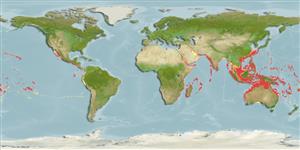
Indo-Pacific: Red Sea and East Africa to the central Pacific, not including Hawaii and the Leeward Islands. Replaced by Myrichthys magnificus in the Hawaiian Islands (Ref. 26145, 37816).
Tamaño / Peso / Edad
Madurez: Lm ? range ? - ? cm
Max length : 100.0 cm TL macho / no sexado; (Ref. 1602); common length : 50.0 cm TL macho / no sexado; (Ref. 9137)
Descripción breve
Claves de identificación | Morfología | Morfometría
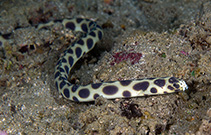
Espinas dorsales (total) : 0; Radios blandos dorsales (total) : 0; Espinas anales: 0; Radios blandos anales: 0; Vértebra: 185 - 189. Pale cream in color with variable pattern of large and small black spots with narrower white interspaces (Ref. 3972, 48635). Young with black saddles (Ref. 3972). Its behavior is similar to Myrichthys colubrinus and Leiuranus semicinctus.
Body shape (shape guide): eel-like; Cross section: circular.
Found in sandy areas of reef flats, lagoons, and seaward reefs; living buried in the sand. May aggregate in large numbers under a light at night (Ref. 9710). Sometimes fully exposed when searching for prey (Ref. 30874). Feeds on small fishes and crustaceans (Ref. 89972). Solitary and more common at night (Ref 90102).
Ciclo vital y comportamiento de apareamiento
Madurez | Reproducción | Puesta | Huevos | Fecundidad | Larva
McCosker, J.E. and R.H. Rosenblatt, 1993. A revision of the snake eel genus Myrichthys (Anguilliformes: Ophichthidae) with the description of a new eastern Pacific species. Proc. Calif. Acad. Sci. 48(8):153-169. (Ref. 40867)
Situación en la Lista Roja de la UICN (Ref. 130435: Version 2025-2 (Global))
Amenaza para el ser humano
Harmless
Usos humanos
Pesquerías: comercial; Acuario: Comercial
Herramientas
Informes especiales
Descargar XML
Fuentes de Internet
Estimaciones basadas en modelos
Temperatura preferida (Referencia
123201): 19.2 - 28.2, mean 26.1 °C (based on 991 cells).
Índice de diversidad filogenética (Referencia
82804): PD
50 = 0.5005 [Uniqueness, from 0.5 = low to 2.0 = high].
Bayesian length-weight: a=0.00093 (0.00041 - 0.00214), b=2.99 (2.79 - 3.19), in cm total length, based on LWR estimates for this (Sub)family-body shape (Ref.
93245).
Nivel trófico (Referencia
69278): 3.6 ±0.5 se; based on size and trophs of closest relatives
Resiliencia (Referencia
120179): Medio, población duplicada en un tiempo mínimo de 1.4-4.4 años (Preliminary K or Fecundity.).
Vulnerabilidad pesquera (Ref.
59153): High vulnerability (60 of 100).
🛈
Nutrientes (Ref.
124155): Calcium = 29.1 [15.6, 50.6] mg/100g; Iron = 0.466 [0.280, 0.952] mg/100g; Protein = 18.7 [16.4, 21.2] %; Omega3 = 0.121 [0.054, 0.337] g/100g; Selenium = 67.5 [38.0, 129.7] μg/100g; VitaminA = 42.2 [13.0, 130.0] μg/100g; Zinc = 0.849 [0.605, 1.190] mg/100g (wet weight);