>
Blenniiformes (Blennies) >
Clinidae (Clinids)
Etymology: Pavoclinus: Latin, pavo = peacock + Greek, klino, klinein = to incline (Ref. 45335).
More on authors: Gilchrist & Thompson.
Entorno: milieu / zona climática / rango de profundidad / gama de distribución
Ecología
marino demersal. Subtropical; 27°S - 35°S
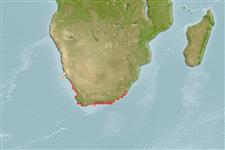
Southeast Atlantic: Lüderitzbucht, Namibia to the Kei River, South Africa.
Tamaño / Peso / Edad
Madurez: Lm ? range ? - ? cm
Max length : 15.0 cm TL macho / no sexado; (Ref. 5496)
Descripción breve
Claves de identificación | Morfología | Morfometría
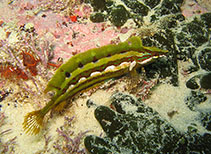
Espinas dorsales (total) : 30 - 36; Radios blandos dorsales (total) : 2 - 4; Espinas anales: 2; Radios blandos anales: 20 - 23. Color depends on the weed in which it is found; often with pearly spots on body; preserved specimens uniform yellow in color (Ref. 5496).
Body shape (shape guide): elongated.
Found among weed at low tide mark (Ref. 5496).
Ciclo vital y comportamiento de apareamiento
Madurez | Reproducción | Puesta | Huevos | Fecundidad | Larva
Smith, M.M., 1986. Clinidae. p. 758-769. In M.M. Smith and P.C. Heemstra (eds.) Smiths' sea fishes. Springer-Verlag, Berlin. (Ref. 5496)
Situación en la Lista Roja de la UICN (Ref. 130435: Version 2025-2 (Global))
Amenaza para el ser humano
Harmless
Usos humanos
Herramientas
Informes especiales
Descargar XML
Fuentes de Internet
Estimaciones basadas en modelos
Temperatura preferida (Referencia
123201): 16.1 - 22.6, mean 18.6 °C (based on 64 cells).
Índice de diversidad filogenética (Referencia
82804): PD
50 = 0.5020 [Uniqueness, from 0.5 = low to 2.0 = high].
Bayesian length-weight: a=0.00501 (0.00221 - 0.01134), b=3.06 (2.86 - 3.26), in cm total length, based on LWR estimates for this (Sub)family-body shape (Ref.
93245).
Nivel trófico (Referencia
69278): 3.3 ±0.53 se; based on food items.
Resiliencia (Referencia
120179): Alto, población duplicada en un tiempo mínimo inferior a 15 meses (Preliminary K or Fecundity.).
Vulnerabilidad pesquera (Ref.
59153): Low vulnerability (10 of 100).
🛈