>
Anguilliformes (Eels and morays) >
Moringuidae (Worm or spaghetti eels)
Etymology: Neoconger: Name from the Latin neo, new, and Conger, a genus of eels. Apparently referring to a resemblance to the Congridae; mucronatus: Name from Latin 'mucro' for sharp or pointed and 'natus' for born; apparently referring to the relatively pointed anterior end of the head.
More on author: Girard.
Ambiente: milieu / zona climatica / distribuzione batimetrica / gamma di distribuzione
Ecologia
marino demersale; distribuzione batimetrica 12 - 170 m (Ref. 133039). Subtropical
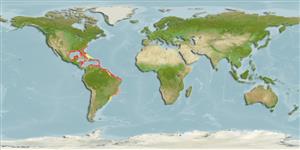
West Atlantic: western Gulf of Mexico between the mouth of the Mississippi River and the Yucatan Peninsula.
Dimensione / Peso / Età
Maturità: Lm ? range ? - ? cm
Max length : 10.7 cm TL maschio/sesso non determinato; (Ref. 133039); 30.0 cm TL (female)
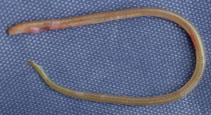
Vertebre: 94 - 99. This species is distinguished by the following characters: differs from the geographically adjacent Neoconger torrei in the total number of vertebrae, 94-99 (vs. 104-107); differs from N. anaelisae in the number of predorsal vertebrae, 38-44 (vs. 32-34); differs from N. hygomi in the number of predorsal vertebrae 38-44 (vs. 48), preanal vertebrae 43-47 (vs. 55), precaudal vertebrae ca. 50-52 (vs. 58), and total vertebrae 94-99 (vs. 107); differs from N. vermiformis in the number of predorsal vertebrae 38-44 (vs. 34-38), preanal vertebrae 43-47 (vs. 41-44), and precaudal vertebrae ca. 50–52 (vs. 45–ca 49). The larvae have a sharp intestinal loop; with posterior lateral melanophore present, while the anterior ventral melanophore is absent (Ref. 133039).
Body shape (shape guide): eel-like; Cross section: oval.
Inhabits offshore banks (Ref. 7251). This area is characterized by predominantly muddy bottoms (Ref. 133039).
Ciclo vitale e comportamento di accoppiamento
Maturità | Riproduzione | Deposizione | Uova | Fecondità | Larve
Smith, D.G., A.P. Marceniuk, M.M. Rotundo, C.O. Carvalho and R.A. Caires, 2024. A review of the genus Neoconger (Anguilliformes: Moringuidae), with the description of a new species. Zootaxa 5492 (1):109-128. (Ref. 133039)
Stato della Lista Rossa IUCN (Ref. 130435: Version 2025-2 (Global))
Minaccia per l'uomo
Harmless
Usi umani
Pesca: di nessun interesse
Strumenti
Rapporti speciali
Scarica XML
Fonti Internet
Stime basate su modelli
Temperatura preferita (Fonte Biblio.
123201): 18.6 - 27.5, mean 24.6 °C (based on 212 cells).
Indice di diversità filogenetica (Fonte Biblio.
82804): PD
50 = 0.5156 [Uniqueness, from 0.5 = low to 2.0 = high].
Bayesian length-weight: a=0.00102 (0.00046 - 0.00225), b=3.06 (2.88 - 3.24), in cm total length, based on all LWR estimates for this body shape (Ref.
93245).
Livello trofico (Fonte Biblio.
69278): 3.2 ±0.3 se; based on size and trophs of closest relatives
Vulnerabilità della pesca (Ref.
59153): Low vulnerability (20 of 100).
🛈