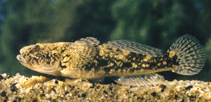
>
Gobiiformes (Gobies) >
Gobiidae (Gobies) > Gobiinae
Eponymy: Karl Fedorovich (Theodorovich) Kessler (1815–1881) was a Russian-German zoologist and collector who was one of the founders of the St Petersburg Society of Naturalists (1868), and its President (1868–1879). [...] (Ref. 128868), visit book page.
More on author: Günther.
Entorno: milieu / zona climática / rango de profundidad / gama de distribución
Ecología
; agua dulce; salobre bentopelágico. Temperate; 4°C - 20°C (Ref. 2059); 50°N - 43°N, 26°E - 52°E
Europe and Asia: Danube delta (Braila, Lake Brates); Lakes Kagul, Yalpukh, Katlabukh, Kitai. Dniester from the liman to the region of Kamentes-Podol'sk. Dnieper to Dnepropetrovsk; Odessa and all coasts of the Caspian Sea; and Volga at Astrakhan. Absent from the Sea of Azov. In Ref. 92840, it reported that this species reached the North Sea basin through an artificial waterway connecting the Danube with the Rhine (well-documented) and within 4 years, the species colonized all suitable riverhabitats downstream of the invasion site.
Tamaño / Peso / Edad
Madurez: Lm ? range ? - ? cm
Max length : 22.0 cm TL macho / no sexado; (Ref. 556)
Descripción breve
Claves de identificación | Morfología | Morfometría
This species is distinguished from related species in the Black Sea basin by the following characters: 75-95 % of distance between its origin and anus; ctenoid scales completely cover predorsal area and nape; pelvic disc fraenum with angular lobes, fraenum length 1/6-1/2 of its width at base; scales in midlateral series 68-72 + 3-4; snout length 1.5-2.0 times in eye diameter; first branched ray of second dorsal about as long as penultimate ray; posterior part of first dorsal without black spot (Ref. 59043).
Body shape (shape guide): fusiform / normal.
Usually in freshwater and brackish water with very low salinity (< 2 ppt); in lower rivers and lagoons, lakes, large rivers, harbours on rocky or well-vegetated bottom (reed thickets) in still waters as well as rapids. Initial spawning at 2 years, in March to May, where adhesive eggs are deposited on stones, shells and aquatic plants; while males guard the eggs until hatching. (Ref. 59043). Feeds on crustaceans (mysids, corophiid amphipods) and small fish (gobies) (Ref. 4696).
Adhesive eggs deposited on stones, shells and aquatic plants. Males guard eggs until hatching. (Ref.59043).
Kottelat, M., 1997. European freshwater fishes. An heuristic checklist of the freshwater fishes of Europe (exclusive of former USSR), with an introduction for non-systematists and comments on nomenclature and conservation. Biologia, Bratislava, 52/Suppl. 5:1-271. (Ref. 13696)
Situación en la Lista Roja de la UICN (Ref. 130435: Version 2025-2 (Global))
Amenaza para el ser humano
Harmless
Usos humanos
Pesquerías: comercial
Herramientas
Informes especiales
Descargar XML
Fuentes de Internet
Estimaciones basadas en modelos
Índice de diversidad filogenética (Referencia
82804): PD
50 = 0.5000 [Uniqueness, from 0.5 = low to 2.0 = high].
Bayesian length-weight: a=0.01023 (0.00477 - 0.02194), b=3.01 (2.83 - 3.19), in cm total length, based on LWR estimates for this (Sub)family-body shape (Ref.
93245).
Nivel trófico (Referencia
69278): 3.5 ±0.53 se; based on food items.
Resiliencia (Referencia
120179): Medio, población duplicada en un tiempo mínimo de 1.4-4.4 años (Preliminary K or Fecundity).
Vulnerabilidad pesquera (Ref.
59153): Low vulnerability (12 of 100).
🛈