>
Syngnathiformes (Pipefishes and seahorses) >
Syngnathidae (Pipefishes and seahorses) > Syngnathinae
Etymology: Hippocampus: Greek, ippos = horse + Greek,kampe = curvature (Ref. 45335).
More on author: Weber.
Environnement : milieu / zone climatique / profondeur / gamme de distribution
Écologie
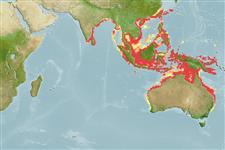
marin; saumâtre récifal; non migrateur; profondeur 10 - 80 m (Ref. 42735). Subtropical; 22°C - 27°C (Ref. 130605); 27°N - 36°S, 76°E - 155°E
Indo-Pacific: India and Sri Lanka to Australia; north to China.
Longueur à la première maturité / Taille / Poids / Âge
Maturité: Lm 10.4 range ? - ? cm
Max length : 18.0 cm OT mâle / non sexé; (Ref. 48635); 13.6 cm OT (female)
Description synthétique
Clés d'identification | Morphologie | Morphométrie
Épines dorsales (Total) : 0; Rayons mous dorsaux (Total) : 16 - 20.
Body shape (shape guide): other; Cross section: angular.
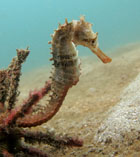
Found in the continental shelf, on muddy, sandy bottoms, rubbles and in coral reefs (Ref. 75154); in a sponge or seagrass habitat, often attached to hard and soft coral species (Ref. 128284). Ovoviviparous (Ref. 205). The male carries the eggs in a brood pouch which is found under the tail (Ref. 205). Maximum length is based on a straight-line length measurement from upper surface (ignoring spines) of first trunk ring, to tip of tail; female 13.8 cm (Ref. 42735). Less desirable for traditional Chinese medicine, but use may increase with the rise in patent medicines. Taken in trawls (Ref. 42735).
Male carries the eggs in a brood pouch (Ref. 205).
Lourie, S.A., R.A. Pollom and S.J. Foster, 2016. A global revision of the seahorses Hippocampus Rafinesque 1810 (Actinopterygii: Syngnathiformes): taxonomy and biogeography with recommendations for further research. Zootaxa 4146(1):1-66. (Ref. 115213)
Statut dans la liste rouge de l'IUCN (Ref. 130435: Version 2025-2 (Global))
Menace pour l'homme
Harmless
Utilisations par l'homme
Pêcheries: commercial; Aquarium: Commercial
Outils
Articles particuliers
Télécharger en XML
Sources Internet
Estimations basées sur des modèles
Température préférée (Réf.
123201): 24.3 - 29.2, mean 28.3 °C (based on 992 cells).
Indice de diversité phylogénétique (Réf.
82804): PD
50 = 0.5000 [Uniqueness, from 0.5 = low to 2.0 = high].
Bayesian length-weight: a=0.00447 (0.00176 - 0.01132), b=3.00 (2.78 - 3.22), in cm total length, based on LWR estimates for this (Sub)family-body shape (Ref.
93245).
Niveau trophique (Réf.
69278): 3.4 ±0.4 se; based on size and trophs of closest relatives
Résilience (Réf.
120179): Haut, temps minimum de doublement de population inférieur à 15 mois (tm=0.5-1).
Vulnérabilité de la pêche (Ref.
59153): Low vulnerability (10 of 100).
🛈
Nutriments (Ref.
124155): Calcium = 66.6 [31.9, 177.6] mg/100g; Iron = 0.848 [0.431, 1.529] mg/100g; Protein = 18.9 [17.6, 20.0] %; Omega3 = 0.209 [0.109, 0.393] g/100g; Selenium = 18.3 [7.4, 43.1] μg/100g; VitaminA = 39.7 [10.8, 147.1] μg/100g; Zinc = 1.27 [0.77, 1.98] mg/100g (wet weight);