>
Syngnathiformes (Pipefishes and seahorses) >
Syngnathidae (Pipefishes and seahorses) > Syngnathinae
Etymology: Hippocampus: Greek, ippos = horse + Greek,kampe = curvature (Ref. 45335).
More on author: Rüppell.
Taxonomic Remarks
This species is a synonym of Hippocampus kuda Weber, 1913 according to Lourie et al., 2016 (Ref. 115213). This species record will be removed.
Umwelt: Milieu / Klimazone / Tiefenbereich / Verbreitungsgebiet
Ökologie
seewasser demersal; amphidrom (Ref. 52884); tiefenbereich 0 - 10 m (Ref. 52034). Tropical
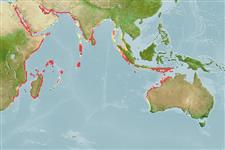
Indian Ocean: Red Sea, Saudi Arabia, Djibouti, and Sri Lanka. Records from South Africa, Madagascar, Mauritius and Réunion are questionable.
Länge bei der ersten Reifung / Größe / Gewicht / Alter
Geschlechtsreife: Lm 8.0 range ? - ? cm
Max length : 14.4 cm OT Männchen/unbestimmt; (Ref. 47822)
Kurzbeschreibung
Bestimmungsschlüssel | Morphologie | Morphometrie
Rückenflossenstacheln (insgesamt) : 0; Rückenflossenweichstrahlen (insgesamt) : 14 - 17.
Body shape (shape guide): other.
Length type refers to height (= TL - head length). Occurs in eelgrass beds (Zostera sp.) in lagoons. Used in India for traditional medicines. Diurnal. Adults pair-bond and greet on daily basis in the laboratory (Ref. 30915). Ovoviviparous (Ref. 205). The male carries the eggs in a brood pouch which is found under the tail (Ref. 205). Monogamous and always in home-ranging pairs, that is they do not defend an exclusive territory (Ref. 52884).
Adults pair-bond and greet on a daily basis in the laboratory (Ref. 35709). Monogamous mating is observed as both obligate and genetic (Ref. 52884). Male carries the eggs in a brood pouch (Ref. 205). Gestation period is about 14 days depending on temperature (Ref. 30915). Clutch size is about 30-140 (from dropped clutches) (Ref. 30915).
Lourie, S.A., A.C.J. Vincent and H.J. Hall, 1999. Seahorses: an identification guide to the world's species and their conservation. Project Seahorse, London. 214 p. (Ref. 30915)
IUCN Rote Liste Status (Ref. 130435: Version 2025-2 (Global))
Bedrohung für Menschen
Harmless
Nutzung durch Menschen
Fischereien: weniger kommerziell
Tools
Zusatzinformationen
Download XML
Internet Quellen
Schätzungen auf der Grundlage von Modellen
Bevorzugte Temperatur (Ref.
123201): 24.8 - 29.3, mean 28.2 °C (based on 1106 cells).
Phylogenetischer Diversitätsindex (Ref.
82804): PD
50 = 0.5000 [Uniqueness, from 0.5 = low to 2.0 = high].
Bayesian length-weight: a=0.00447 (0.00176 - 0.01132), b=3.00 (2.78 - 3.22), in cm total length, based on LWR estimates for this (Sub)family-body shape (Ref.
93245).
Trophische Ebene (Ref.
69278): 3.4 ±0.4 se; based on size and trophs of closest relatives
Widerstandsfähigkeit (Ref.
120179): hoch, Verdopplung der Population dauert weniger als 15 Monate. (tm=0.3-0.4).
Anfälligkeit der Fischerei (Ref.
59153): Low vulnerability (10 of 100).
🛈