>
Acipenseriformes (Sturgeons and paddlefishes) >
Acipenseridae (Sturgeons)
Etymology: Acipenser: Latin, acipenser = sturgeon, 1853 (Ref. 45335); transmontanus: The specific name is derived from the Latin acipenser (sturgeon), trans (beyond), and montanus (mountain) (Ref. 27436).
More on author: Richardson.
Ambiente: milieu / zona climatica / distribuzione batimetrica / gamma di distribuzione
Ecologia
marino; acqua dolce; salmastro demersale; anadromo (Ref. 138280); distribuzione batimetrica 1 - 122 m (Ref. 27547). Temperate; 0°C - 23°C (Ref. 1998); 58°N - 24°N, 163°W - 107°W (Ref. 54269)
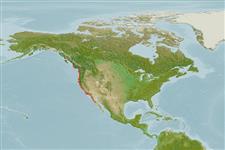
Eastern Pacific: Alaska Bay to Monterey, California, USA. Landlocked in Columbia River drainage, Montana, and perhaps Lake Shasta in California, USA. Translocated to lower Colorado River, Arizona in USA. Reported from northern Baja California, Mexico (Ref. 2850, 27436).
Lunghezza alla prima maturità / Dimensione / Peso / Età
Maturità: Lm 160.0 range ? - ? cm
Max length : 610 cm TL maschio/sesso non determinato; (Ref. 1998); common length : 21.0 cm TL maschio/sesso non determinato; (Ref. 12193); peso massimo pubblicato: 816.0 kg (Ref. 27436); Età massima riportata: 104 anni (Ref. 39377)
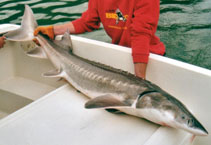
Spine dorsali (totale) : 0; Raggi dorsali molli (totale) : 44 - 48; Raggi anali molli: 28 - 31. Distinguished by the 2 rows of 4 to 8 bony plates on a midventral line between the anus and anal fin, and about 45 rays in the dorsal fin (Ref. 27547). Gray or brownish above, paler below; fins gray (Ref. 27547). Barbels situated closer to snout tip than to mouth; no obvious scutes behind dorsal and anal fins (Ref. 86798).
Body shape (shape guide): elongated.
Spends most of its time in the sea, usually close to shore (Ref. 27547). Enters estuaries of large rivers and moves far inland to spawn (Ref. 5723). Individuals larger than 48.3 cm feed mainly on fishes; smaller ones feed mainly on chironomids, but also takes small crustaceans, other insects and mollusks (Ref. 1998). Feeding ceases just before spawning (Ref. 1998). Excellent food fish that is sold fresh, smoked or frozen (Ref. 9988). Eggs marketed as caviar (Ref. 1998). In the past, the airbladder was made into isinglass (Ref. 27547).
Adults return to the sea after spawning (Ref. 27547). Spawning frequency interval every 4 years for younger females and every 10-11 years in older females (Ref. 1998).
Page, L.M. and B.M. Burr, 1991. A field guide to freshwater fishes of North America north of Mexico. Houghton Mifflin Company, Boston. 432 p. (Ref. 5723)
Stato della Lista Rossa IUCN (Ref. 130435: Version 2025-2 (Global))
Minaccia per l'uomo
Harmless
Usi umani
Pesca: commerciale; Acquacoltura: commerciale; Pesce da pesca sportiva: si
Strumenti
Rapporti speciali
Scarica XML
Fonti Internet
Stime basate su modelli
Temperatura preferita (Fonte Biblio.
123201): 8.3 - 12.2, mean 9.7 °C (based on 80 cells).
Indice di diversità filogenetica (Fonte Biblio.
82804): PD
50 = 0.5000 [Uniqueness, from 0.5 = low to 2.0 = high].
Bayesian length-weight: a=0.00309 (0.00156 - 0.00614), b=3.19 (3.02 - 3.36), in cm total length, based on LWR estimates for this species & Genus-body shape (Ref.
93245).
Livello trofico (Fonte Biblio.
69278): 3.3 ±0.1 se; based on diet studies.
Generation time: 27.5 ( na - na) years. Estimated as median ln(3)/K based on 1
growth studies.
Resilienza (Fonte Biblio.
120179): Molto basso, tempo minimo di raddoppiamento della popolazione più di 14 anni (tm=11-34; tmax=104).
Vulnerabilità della pesca (Ref.
59153): Very high vulnerability (87 of 100).
🛈
Vulnerabilità climatica (Ref.
125649): Moderate to high vulnerability (48 of 100).
🛈
Nutrienti (Ref.
124155): Calcium = 8.84 [4.78, 17.65] mg/100g; Iron = 0.244 [0.136, 0.429] mg/100g; Protein = 17.4 [14.8, 20.2] %; Omega3 = 0.293 [0.147, 0.585] g/100g; Selenium = 31.4 [14.7, 69.3] μg/100g; VitaminA = 4.45 [1.29, 16.47] μg/100g; Zinc = 0.377 [0.252, 0.570] mg/100g (wet weight);