>
Myctophiformes (Lanternfishes) >
Myctophidae (Lanternfishes) > Gymnoscopelinae
Etymology: Lampanyctodes: Greek, lampas, -ados = torch + Greek, nykte = night (Ref. 45335).
Eponymy: Dr Sir James Hector (1834–1907) was a Scottishborn Canadian geologist who took his medical degree at Edinburgh and, as both geologist and surgeon, was part of the Palliser expedition to western North America (1857–1860). [...] (Ref. 128868), visit book page.
More on author: Günther.
Umwelt: Milieu / Klimazone / Tiefenbereich / Verbreitungsgebiet
Ökologie
seewasser pelagic-oceanic; ozeanodrom (Ref. 51243); tiefenbereich 0 - ? m (Ref. 4479). Tropical; 13°S - 43°S
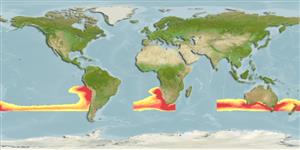
Eastern Atlantic: Benguela Upwelling Region south of about 19°S. Western Pacific: off southern Australia and New Zealand. Eastern Pacific: Chile.
Größe / Gewicht / Alter
Geschlechtsreife: Lm ? range ? - ? cm
Max length : 7.0 cm SL Männchen/unbestimmt; (Ref. 7003); max. veröff. Alter: 3.00 Jahre (Ref. 7003)
Rückenflossenstacheln (insgesamt) : 0; Rückenflossenweichstrahlen (insgesamt) : 13 - 15; Afterflossenstacheln: 0; Afterflossenweichstrahlen: 15 - 17.
Body shape (shape guide): elongated.
Pseudoceanic (Ref. 4066). Occurs in neritic fish community over the continental shelf (Ref. 42649). Nyctoepipelagic at the surface (Ref. 4479). Eggs of this species have been reported immediately beneath the water surface (Ref. 9212). Lipid content is 20 % in fresh body weight (Ref. 8966). Processed into fishmeal (Ref. 4066).
Lebenszyklus und Paarungsverhalten
Geschlechtsreife | Fortpflanzung | Ablaichen | Eier | Fruchtbarkeit | Larven
Hulley, P.A., 1990. Myctophidae. p. 398-467. In J.C. Quero, J.C. Hureau, C. Karrer, A. Post and L. Saldanha (eds.) Check-list of the fishes of the eastern tropical Atlantic (CLOFETA). JNICT, Lisbon; SEI; Paris; and UNESCO, Paris. Vol. 1. (Ref. 4479)
IUCN Rote Liste Status (Ref. 130435: Version 2025-2 (Global))
Bedrohung für Menschen
Harmless
Nutzung durch Menschen
Fischereien: kommerziell
Tools
Zusatzinformationen
Download XML
Internet Quellen
Schätzungen auf der Grundlage von Modellen
Bevorzugte Temperatur (Ref.
123201): 13.4 - 18.2, mean 15.5 °C (based on 201 cells).
Phylogenetischer Diversitätsindex (Ref.
82804): PD
50 = 1.0000 [Uniqueness, from 0.5 = low to 2.0 = high].
Bayesian length-weight: a=0.00427 (0.00197 - 0.00923), b=3.16 (2.97 - 3.35), in cm total length, based on LWR estimates for this (Sub)family-body shape (Ref.
93245).
Trophische Ebene (Ref.
69278): 3.2 ±0.24 se; based on food items.
Generation time: 3.5 ( na - na) years. Estimated as median ln(3)/K based on 1
growth studies.
Widerstandsfähigkeit (Ref.
120179): hoch, Verdopplung der Population dauert weniger als 15 Monate. (K=0.31; tmax=3).
Anfälligkeit der Fischerei (Ref.
59153): Low vulnerability (10 of 100).
🛈
Klimaanfälligkeit (Ref.
125649): High vulnerability (58 of 100).
🛈
Nährstoffe (Ref.
124155): Calcium = 478 [171, 1,637] mg/100g; Iron = 2.32 [0.97, 5.85] mg/100g; Protein = 16.3 [14.2, 18.4] %; Omega3 = 0.523 [0.213, 1.390] g/100g; Selenium = 66 [23, 211] μg/100g; VitaminA = 69.2 [17.2, 345.4] μg/100g; Zinc = 2.06 [1.20, 3.43] mg/100g (wet weight);