>
Eupercaria/misc (Various families in series Eupercaria) >
Labridae (Wrasses) > Cirrhilabrinae
Etymology: Paracheilinus: Greek, para = the side of + Greek, chaite = hair + Greek, odous = teeth (Ref. 45335).
Eponymy: Lori Jane Colin née Bell is a marine biologist. [...] (Ref. 128868), visit book page.
More on author: Randall.
Umwelt: Milieu / Klimazone / Tiefenbereich / Verbreitungsgebiet
Ökologie
seewasser riff-verbunden; tiefenbereich 18 - 31 m (Ref. 9710). Tropical
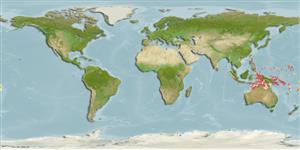
Western Central Pacific: Kwajalein Atoll, Marshall Islands. Replaced by Paracheilinus filamentosus from the Philippines (Ref. 37816).
Größe / Gewicht / Alter
Geschlechtsreife: Lm ? range ? - ? cm
Max length : 6.5 cm TL Männchen/unbestimmt; (Ref. 9710)
Rückenflossenstacheln (insgesamt) : 9; Rückenflossenweichstrahlen (insgesamt) : 11; Afterflossenstacheln: 3; Afterflossenweichstrahlen: 9. Females and juveniles lack the elongate dorsal and caudal fin lobes and electric colors of the males (Ref. 37816). Tubed peduncular scales 5-6; no distinct stripes on body (Ref. 41634).
Body shape (shape guide): fusiform / normal.
Found among dense algal beds of deep lagoons.
Lebenszyklus und Paarungsverhalten
Geschlechtsreife | Fortpflanzung | Ablaichen | Eier | Fruchtbarkeit | Larven
Oviparous, distinct pairing during breeding (Ref. 205).
Lieske, E. and R. Myers, 1994. Collins Pocket Guide. Coral reef fishes. Indo-Pacific & Caribbean including the Red Sea. Haper Collins Publishers, 400 p. (Ref. 9710)
IUCN Rote Liste Status (Ref. 130435: Version 2025-2 (Global))
Bedrohung für Menschen
Harmless
Nutzung durch Menschen
Tools
Zusatzinformationen
Download XML
Internet Quellen
Schätzungen auf der Grundlage von Modellen
Bevorzugte Temperatur (Ref.
123201): 27.5 - 28.9, mean 28.3 °C (based on 22 cells).
Phylogenetischer Diversitätsindex (Ref.
82804): PD
50 = 0.5000 [Uniqueness, from 0.5 = low to 2.0 = high].
Bayesian length-weight: a=0.01072 (0.00427 - 0.02691), b=3.03 (2.81 - 3.25), in cm total length, based on LWR estimates for this (Sub)family-body shape (Ref.
93245).
Trophische Ebene (Ref.
69278): 3.4 ±0.45 se; based on food items.
Widerstandsfähigkeit (Ref.
120179): hoch, Verdopplung der Population dauert weniger als 15 Monate. (Preliminary K or Fecundity.).
Anfälligkeit der Fischerei (Ref.
59153): Low vulnerability (10 of 100).
🛈