Taxonomic Remarks
Eastern Atlantic populations of Bathytoshia centroura refer to Bathytoshia lata according to Last et al, 2016 (Ref. 114953). Species distribution will be corrected as soon as possible;
Môi trường: môi trường / vùng khí hậu / Mức độ sâu / phạm vi phân phối
Sinh thái học
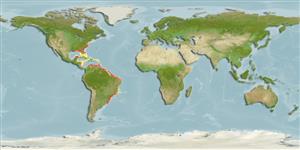
biển; thuộc về nước lợ gần đáy; mức độ sâu 3 - 270 m (Ref. 57911), usually 15 - 50 m (Ref. 4438). Subtropical; 45°N - 35°S, 90°W - 36°E
Western Atlantic: antitropical; from western and southern USA, including the Gulf of Mexico, and Brazil to Argentina (Ref. 114953). Eastern Atlantic populations refer to Bathytoshia lata (Ref. 109651, 114953).
Chiều dài lúc trưởng thành đầu tiên / Bộ gần gũi / Khối lượng (Trọng lượng) / Tuổi
Chín muồi sinh dục: Lm 116.5, range 66 - 160 cm
Max length : 300 cm TL con đực/không giới tính; (Ref. 27549); common length : 125 cm WD con đực/không giới tính; (Ref. 26999); Khối lượng cực đại được công bố: 300.0 kg (Ref. 57911)
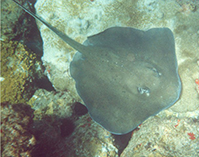
Diagnosis: Large specimens of Dasyatis centroura are recognizable by their thorny tails, by the large size and wide spacing spacing of their mid-dorsal bucklers, and by the conspicuous tubercles or bucklers on the outer parts of their discs; in smaller specimens the large tubercles have not yet developed on the tail (Ref. 6902). It differs from Dasyatis sabina, D. guttata and Himantura schmardae in the shape of disc; it resembles Dasyatis say and D. americana in shape of disc, but it can be distinguished from D. say by the fact that the tail lacks any trace of a cutaneous fold above, and from D. americana by its much narrower ventral tailfold (Ref. 6902).
Body shape (shape guide): other; Cross section: flattened.
Dasyatis centroura is a coastal species (Ref. 81259), found over sandy and muddy bottoms (Ref. 3169). It feeds on bottom-living invertebrates and fishes (Ref. 3169). Ovoviviparous (Ref. 6901). Wings marketed fresh, smoked, dried-salted; used for fishmeal and oil. Harmful to shellfish banks; dangerous to bathers and fishers due to its poisonous spine. May attain well over 100 cm TL. Warm season visitor to coastal waters (Ref. 6902).
Exhibit ovoviparity (aplacental viviparity), with embryos feeding initially on yolk, then receiving additional nourishment from the mother by indirect absorption of uterine fluid enriched with mucus, fat or protein through specialised structures (Ref. 50449). Gestation about 4 months with 2 to 4 young produced in autumn and early winter (Ref. 6901). Distinct pairing with embrace (Ref. 205).
Last, P.R., W.T. White, M.R. de Carvalho, B. Séret, M.F.W. Stehmann and G.J.P. Naylor, 2016. Rays of the world. CSIRO Publishing, Comstock Publishing Associates. i-ix + 1-790. (Ref. 114953)
Tình trạng Sách đỏ IUCN (Ref. 130435: Version 2025-2 (Global))
Mối đe dọa đối với con người
Venomous
Sử dụng của con người
Các nghề cá: buôn bán nhỏ; cá để chơi: đúng
Các công cụ
Báo cáo đặc biệt
Tải xuống XML
Các nguồn internet
Ước tính dựa trên mô hình
Nhiệt độ ưa thích (Tài liệu tham khảo
123201): 14.6 - 27.7, mean 23.1 °C (based on 772 cells).
Chỉ số đa dạng phát sinh loài (Tài liệu tham khảo
82804): PD
50 = 0.6250 [Uniqueness, from 0.5 = low to 2.0 = high].
Bayesian length-weight: a=0.00447 (0.00189 - 0.01058), b=3.12 (2.92 - 3.32), in cm total length, based on LWR estimates for this (Sub)family-body shape (Ref.
93245).
Mức dinh dưỡng (Tài liệu tham khảo
69278): 3.8 ±0.0 se; based on diet studies.
Thích nghi nhanh (Tài liệu tham khảo
120179): Rất thấp, thời gian nhân đôi của chủng quần tối thiểu là hơn 14 năm (Fec=2-6).
Sự dễ bị tổn thương của nghề đánh cá (Ref.
59153): Very high vulnerability (90 of 100).
🛈
Sự dễ bị tổn thương của khí hậu (Ref.
125649): Moderate vulnerability (39 of 100).
🛈
Chất dinh dưỡng (Ref.
124155): Calcium = 12 [2, 54] mg/100g; Iron = 0.627 [0.158, 1.732] mg/100g; Protein = 23 [20, 26] %; Omega3 = 0.272 [0.080, 0.798] g/100g; Selenium = 34.5 [9.9, 96.0] μg/100g; VitaminA = 3.84 [1.53, 9.51] μg/100g; Zinc = 0.47 [0.24, 0.84] mg/100g (wet weight); based on
nutrient studies.