>
Eupercaria/misc (Various families in series Eupercaria) >
Haemulidae (Grunts) > Plectorhinchinae
Etymology: Plectorhinchus: Greek, plektos = plaited + Greek, rhyngchos = snout (Ref. 45335).
More on author: Linnaeus.
สิ่งแวดล้อม : สิ่งแวดล้อม / เขตภูมิอากาศ / ระดับความลึก / ระยะการกระจายสินค้า
นิเวศวิทยา
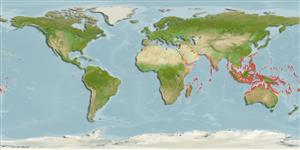
เกี่ยวกับทะเล,น้ำเค็ม เกี่ยวกับหินโสโครก; ระดับความลึก 2 - 25 m (Ref. 37816). Tropical; 30°N - 27°S, 32°E - 167°W
Indo-West Pacific: East Africa (Ref. 33390) to western Indian Ocean to Papua New Guinea and New Caledonia.
ขนาด / น้ำหนัก / อายุ
วัยเจริญพันธุ์: Lm ? range ? - ? cm
Max length : 72.0 cm SL เพศผู้/กระเทย; (Ref. 37816)
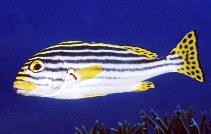
เงี่ยงครีบหลัง (รวม) : 12 - 14; ก้านครีบอ่อนที่หาง (รวม) : 17 - 20; เงี่ยงครีบก้น: 3; ก้านครีบอ่อนที่ก้น: 7 - 8. This species is distinguished by the following characters: chin with 6 pores, no median pit; gill rakers on first gill arch 9-11 + 1 + 20-23 = 29-34; Dorsal fin with XII-XIV (usually XIII),17-20 with 3rd or 4th spines longest; lips fleshy, greatly swollen with age; scales ctenoid (rough to touch); lateral line tubed scales about 55-65; body depth 2.6-2.9 in SL; caudal fin rounded in juveniles, truncate in adults. Colour: juveniles with connected black blotches and spots that gradually break up into horizontal stripes; pectoral fins black in juveniles becoming uniform yellow in adults; tail spotted with age; adults with 6 to 12 broad dark brown, blue-brown or black stripes that persist on the belly and join horizontally across the nape and snout with anterior part of pale interspaces yellow forming 2 bright yellow stripes across interorbital and 2 around snout; eye usually yellow; fins yellow with black margins to vertical fins and black spots, pectoral fins uniform yellow with red-brown, chocolate, or blackish base, pelvic fins yellow with base red-brown, scarlet, or dark brown (Ref. 47695, 90102).
Body shape (shape guide): fusiform / normal; Cross section: compressed.
Inhabits coral reefs and inshore rocky reefs (Ref. 30573). Juveniles solitary, inhabits clear shallow protected lagoon; adults may be solitary or occur in aggregations (Ref. 37816). by handline and spear. Marketed fresh, a small quantity is salted (Ref. 47695).
วงจรชีวิตและพฤติกรรมการผสมพันธุ์
วัยเจริญพันธุ์ | การสืบพันธุ์ | การวางไข่ | เซลสืบพันธ์ของเพศเมีย(ไข่) | ความดกของไข่ | ตัวอ่อน
Oviparous, distinct pairing during breeding (Ref. 205).
Randall, J.E. and C. Anderson, 1993. Annotated checklist of the epipelagic and shore fishes of the Maldives Islands. Ichthyol. Bull. of the J.L.B. Smith Inst. of Ichthyol. (59):1-47. (Ref. 11303)
สถานะบัญชีแดงของ IUCN (Ref. 130435: Version 2025-2 (Global))
ภัยคุกคามต่อมนุษย์
Harmless
การใช้ของมนุษย์
การประมง: การค้า
เครื่องมือ
รายงานพิเศษ
ดาวน์โหลด XML
แหล่งที่มาจากอินเตอร์เน็ต
การประมาณค่าตามแบบจำลอง
อุณหภูมิที่ต้องการ (อ้างอิง
123201): 26.1 - 29.3, mean 28.5 °C (based on 2234 cells).
ดัชนีความหลากหลายทางวิวัฒนาการ (อ้างอิง
82804): PD
50 = 0.5000 [Uniqueness, from 0.5 = low to 2.0 = high].
Bayesian length-weight: a=0.01349 (0.00626 - 0.02905), b=3.00 (2.83 - 3.17), in cm total length, based on LWR estimates for this Genus-body shape (Ref.
93245).
ระดับชั้นอาหาร (อ้างอิง
69278): 3.9 ±0.6 se; based on size and trophs of closest relatives
ความสามารถในการกลับคืนสู่ปกติ (อ้างอิง
120179): ต่ำ, เวลาต่ำสุดที่จะทำให้ประชากรเพิ่มขึ้นเป็น 2 เท่าใช้เวลา 4.5 - 14 ปี (Preliminary K or Fecundity.).
ความเสี่ยงต่อการตกปลา (Ref.
59153): High vulnerability (55 of 100).
🛈
สารอาหาร (Ref.
124155): Calcium = 26.6 [10.3, 49.4] mg/100g; Iron = 0.473 [0.248, 0.897] mg/100g; Protein = 19.4 [17.5, 21.2] %; Omega3 = 0.111 [0.061, 0.186] g/100g; Selenium = 31.9 [18.0, 54.3] μg/100g; VitaminA = 70.3 [26.5, 183.9] μg/100g; Zinc = 1.05 [0.74, 1.52] mg/100g (wet weight);