Klassifizierung / Names
Namen | Synonyme | Catalog of Fishes(Gattung, Arten) | ITIS | CoL | WoRMS | Cloffa
Elasmobranchii (Haie und Rochen) (sharks and rays) >
Rajiformes (Skates and rays) >
Rajidae (Skates)
Etymology: Caliraja: The prefix name Cali- refers to the state of California, United States and Gulf of California, Baja California, Mexico, the regions where the types of all four recognized species were described; stellulata: Name from the Latin stellula meaning small star - scales (Ref. 6885).
More on authors: Jordan & Gilbert.
Umwelt: Milieu / Klimazone / Tiefenbereich / Verbreitungsgebiet
Ökologie
seewasser demersal; tiefenbereich 18 - 982 m (Ref. 112456), usually 70 - 150 m (Ref. 112456). Temperate; 4°C - 12°C (Ref. 112456); 51°N - 30°N, 129°W - 115°W (Ref. 112456)
Northeast Pacific: northern California (USA) to Baja California (Mexico).
Größe / Gewicht / Alter
Geschlechtsreife: Lm ? range ? - ? cm
Max length : 76.0 cm TL Männchen/unbestimmt; (Ref. 2850)
Kurzbeschreibung
Bestimmungsschlüssel | Morphologie | Morphometrie
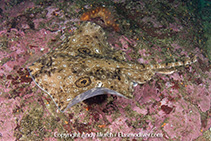
Rückenflossenstacheln (insgesamt) : 0; Afterflossenstacheln: 0. A row of strong, sharp spines along the mid-dorsal line from a point behind the eyes by less than the interorbital width to the first dorsal fin and continued beyond it with a single spine between the two dorsal fins; large spines on the shoulder girdle; a row of small spines on the inner edge of the orbit; a cluster of moderate spines along the edge of the pectoral fin from its tip to the snout, large spines in males (Ref. 6885). Dorsal fins small and well back on tail; caudal fin very small; anal fin absent; pectorals broad, attached to snout and incorporated with body; pelvic fins large and deeply notched (Ref. 6885). A horizontal fleshy ridge from either side of ventral surface of tail, more prominent posteriorly (Ref. 6885). Grayish brown, numerous dark spots of various sizes scattered on body, a weakly marked eye spot frequently present at base of pectoral fins (Ref. 6885).
Body shape (shape guide): other.
A demersal species, commonly found inshore on continental shelf; also found on continental slope. Mainly feeds on small bony fishes, cephalopods and shrimps (Ref. 114953). Oviparous. Distinct pairing with embrace. Young may tend to follow large objects, such as their mother (Ref. 205). Eggs are oblong capsules with stiff pointed horns at the corners deposited in sandy or muddy flats (Ref. 205). Egg capsules are 7.1-7.8 cm long and 5.5-7.0 cm wide (Ref. 41300). Males reaches maturity at ca. 67 cm TL, females at ca. 68 cm TL; young hatch at 12-16 cm TL (Ref. 114953).
Oviparous, paired eggs are laid. Embryos feed solely on yolk (Ref. 50449). Distinct pairing with embrace. Young may tend to follow large objects, such as their mother (Ref. 205).
McEachran, J.D. and K.A. Dunn, 1998. Phylogenetic analysis of skates, a morphologically conservative clade of elasmobranchs (Chondrichthyes: Rajidae). Copeia 1998(2):271-290. (Ref. 27314)
IUCN Rote Liste Status (Ref. 130435: Version 2025-2 (Global))
Bedrohung für Menschen
Harmless
Nutzung durch Menschen
Tools
Zusatzinformationen
Download XML
Internet Quellen
Schätzungen auf der Grundlage von Modellen
Bevorzugte Temperatur (Ref.
123201): 3.5 - 8.3, mean 5.7 °C (based on 180 cells).
Phylogenetischer Diversitätsindex (Ref.
82804): PD
50 = 0.5625 [Uniqueness, from 0.5 = low to 2.0 = high].
Bayesian length-weight: a=0.00302 (0.00141 - 0.00645), b=3.24 (3.07 - 3.41), in cm total length, based on LWR estimates for this (Sub)family-body shape (Ref.
93245).
Trophische Ebene (Ref.
69278): 4.3 ±0.64 se; based on food items.
Generation time: 18.3 ( na - na) years. Estimated as median ln(3)/K based on 1
growth studies.
Widerstandsfähigkeit (Ref.
120179): niedrig, Verdopplung der Population dauert 4,5 - 14 Jahre. (Fec assumed to be <100).
Anfälligkeit der Fischerei (Ref.
59153): High to very high vulnerability (68 of 100).
🛈
Klimaanfälligkeit (Ref.
125649): Moderate vulnerability (45 of 100).
🛈