>
Blenniiformes (Blennies) >
Blenniidae (Combtooth blennies) > Salariinae
Etymology: Entomacrodus: Greek, ento = inside + Greek, makros = big + Greek, odous = teeth (Ref. 45335).
More on author: Valenciennes.
Ambiente: milieu / zona climatica / distribuzione batimetrica / gamma di distribuzione
Ecologia
marino demersale; distribuzione batimetrica 0 - 2 m (Ref. 90102). Tropical
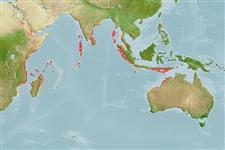
Western Indian Ocean: Seychelles (Ref. 26282) and Maldives. Eastern Indian Ocean: Christmas Island (Ref. 30874).
Dimensione / Peso / Età
Maturità: Lm ? range ? - ? cm
Max length : 18.0 cm TL maschio/sesso non determinato; (Ref. 30874)
Breve descrizione
Chiavi di identificazione | Morfologia | Morfometria
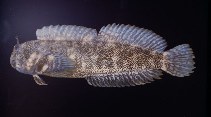
Spine dorsali (totale) : 13; Raggi dorsali molli (totale) : 15 - 17; Spine anali: 2; Raggi anali molli: 16 - 18. Overall greenish, large white blotches superimposed on intricate maze-like pattern, and yellowish margins on median fins. Dorsal rays rarely 15, fin deeply notched; anal rays rarely 16; pectoral rays usually 14; pelvic spine not visible externally; last lateral-line tube below 8th to 13th dorsal spines; nape typically with 1 cirrus on each side; supraorbital tentacle with 2-38 cirri (number proportional with growth); anterior nostril cirri present posteriorly; upper lip margin entirely, but weakly and irregularly crenulate; body depth at anal-fin origin about 4.1-4.5 in SL (Ref. 90102).
Body shape (shape guide): elongated; Cross section: oval.
Facultative air-breathing (Ref. 126274); Adults are found in the intertidal area, actively shuttling back and forth between rock pools and air (Ref. 31184). They breathes air when out of water (Ref. 31184). Oviparous. Eggs are demersal and adhesive (Ref. 205), and are attached to the substrate via a filamentous, adhesive pad or pedestal (Ref. 94114). Larvae are planktonic, often found in shallow, coastal waters (Ref. 94114).
Ciclo vitale e comportamento di accoppiamento
Maturità | Riproduzione | Deposizione | Uova | Fecondità | Larve
Oviparous, distinct pairing (Ref. 205).
Randall, J.E. and C. Anderson, 1993. Annotated checklist of the epipelagic and shore fishes of the Maldives Islands. Ichthyol. Bull. of the J.L.B. Smith Inst. of Ichthyol. (59):1-47. (Ref. 11303)
Stato della Lista Rossa IUCN (Ref. 130435: Version 2025-2 (Global))
Minaccia per l'uomo
Harmless
Usi umani
Strumenti
Rapporti speciali
Scarica XML
Fonti Internet
Stime basate su modelli
Temperatura preferita (Fonte Biblio.
123201): 26.7 - 29.3, mean 28.3 °C (based on 721 cells).
Indice di diversità filogenetica (Fonte Biblio.
82804): PD
50 = 0.5000 [Uniqueness, from 0.5 = low to 2.0 = high].
Bayesian length-weight: a=0.00776 (0.00354 - 0.01702), b=3.00 (2.81 - 3.19), in cm total length, based on LWR estimates for this (Sub)family-body shape (Ref.
93245).
Livello trofico (Fonte Biblio.
69278): 2.0 ±0.00 se; based on food items.
Resilienza (Fonte Biblio.
120179): Medio, tempo minimo di raddoppiamento della popolazione 1.4 - 4.4 anni (Preliminary K or Fecundity.).
Vulnerabilità della pesca (Ref.
59153): Low vulnerability (10 of 100).
🛈