Elasmobranchi (squali e razze) (sharks and rays) >
Rajiformes (Skates and rays) >
Rajidae (Skates)
Etymology: Amblyraja: Greek, amblys = darkness + Latin, raja, -ae = ray (Raja sp.) (Ref. 45335).
Ambiente: milieu / zona climatica / distribuzione batimetrica / gamma di distribuzione
Ecologia
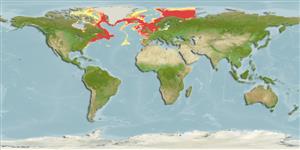
marino; salmastro demersale; oceanodromo (Ref. 51243); distribuzione batimetrica 5 - 1540 m (Ref. 117245), usually 25 - 440 m (Ref. 114953). Boreal; -1°C - 14°C (Ref. 49751); 79°N - 38°N, 95°W - 54°E (Ref. 55275)
North Atlantic and adjacent Arctic.
Lunghezza alla prima maturità / Dimensione / Peso / Età
Maturità: Lm 87.5 range ? - ? cm
Max length : 105 cm TL maschio/sesso non determinato; (Ref. 53748); peso massimo pubblicato: 11.4 kg (Ref. 53748); Età massima riportata: 28 anni (Ref. 88929)
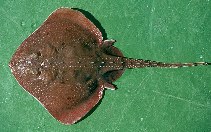
Spine dorsali (totale) : 0; Spine anali: 0. Adults are rhomboid in shape, young are rounder (Ref. 7251). Short, stiff, bluntly triangular snout; tail shorter than body (Ref. 5578). Upper surface very rough, with solid thornlets scattered all over disc and tail, underside smooth, except for some prickles on snout; a constant pattern of separate orbital thorns, a regular row of 13-17 large thorns from nape to first dorsal fin (Ref. 3167); large, close-set thorns with star-shaped bases at upper disc (Ref. 5578). Coloration highly variable; brownish grey with scattered irregular black blotches dorsally; white ventrally; with darker spots and blotches on tail and pelvic fins; black spot on tip of tail (Ref. 2708).
Body shape (shape guide): other.
Eurybathic, eurythermic (Ref. 4426) and benthic (Ref. 58426). Cold temperate species found in offshore waters (Ref. 88171) on all kinds of bottoms (Ref. 3167), mainly sandy and muddy (Ref. 82311). In the northeast Atlantic most common between 50-100 m depth (Ref. 88187) at temperatures of 2-5 °C (Ref. 89120). Some seasonal migrations have been reported from the western Atlantic (Ref. 52109, 89121). Migration experiments showed that 85 % of tagged individuals remained within 93 km of the release site, with longest distance travelled at 180 km (Ref. 82319). Feed mainly on fish, crustaceans (Ref. 5951) and polychaete worms (Ref. 5578), but also on hydroids, molluscs, cephalopods and echinoderms (Ref. 49751); known to be a scavenger (Ref. 89122). Diet changes with increasing body size (Ref. 82311). Different populations of starry rays mature at different ages and sizes (Ref. 88171). Oviparous (Ref. 3167). Maturity size varies from 44-90 cm TL. Young hatch at ca. 8-12 cm TL (Ref. 114953). Young may tend to follow large objects, such as their mother (Ref. 205). Rarely reaches 60 cm in the North Sea (Ref. 88187). Able to detect weak electric fields generated by potential prey organisms and may also generate its own weak electric fields (Ref. 10311). Probably taken by hake trawlers (Ref. 5578). Few are dried and salted in Iceland (Ref. 6902). It is a common Skate whose landings are converted to fish-meal (Ref. 117245). It has been mentioned that North American specimens grow to a larger size than East-Atlantic specimens (Arve Lynghammar, pers.comm., 11/09).
Ciclo vitale e comportamento di accoppiamento
Maturità | Riproduzione | Deposizione | Uova | Fecondità | Larve
Distinct pairing with embrace. Oviparous, laying 10-45 egg cases each year (Ref. 44869, 41305). Eggs are oblong capsules with stiff pointed horns at the corners deposited in sandy or muddy flats (Ref. 205). Egg capsules are 3.4-8.9 cm long and 2.3-6.8 cm wide (Ref. 41250). Paired eggs are laid. Embryos feed solely on yolk (Ref. 50449). In the North Sea, fully formed individuals hatch after 4 months and pups are about 8-11 cm in length (Ref. 44869, 37969). In the Barents Sea, low water temperature may lengthen embryonic development time to 2.5-3 years (Ref. 44869).
McEachran, J.D. and K.A. Dunn, 1998. Phylogenetic analysis of skates, a morphologically conservative clade of elasmobranchs (Chondrichthyes: Rajidae). Copeia 1998(2):271-290. (Ref. 27314)
Stato della Lista Rossa IUCN (Ref. 130435: Version 2025-2 (Global))
Minaccia per l'uomo
Harmless
Usi umani
Pesca: scarso interesse commerciale; Pesce da pesca sportiva: si
Strumenti
Rapporti speciali
Scarica XML
Fonti Internet
Stime basate su modelli
Temperatura preferita (Fonte Biblio.
123201): -0.8 - 5, mean 1 °C (based on 340 cells).
Indice di diversità filogenetica (Fonte Biblio.
82804): PD
50 = 0.5039 [Uniqueness, from 0.5 = low to 2.0 = high].
Bayesian length-weight: a=0.00324 (0.00279 - 0.00375), b=3.24 (3.20 - 3.28), in cm total length, based on LWR estimates for this species (Ref.
93245).
Livello trofico (Fonte Biblio.
69278): 4.2 ±0.3 se; based on diet studies.
Resilienza (Fonte Biblio.
120179): Basso, tempo minimo di raddoppiamento della popolazione 4.5 - 14 anni (K=0.17; tm=4; Fec=13-20).
Prior r = 0.09, 95% CL = 0.06 - 0.13, Based on 1 full stock assessment.
Vulnerabilità della pesca (Ref.
59153): Moderate to high vulnerability (51 of 100).
🛈
Nutrienti (Ref.
124155): Calcium = 7.77 [1.30, 39.92] mg/100g; Iron = 0.366 [0.079, 1.119] mg/100g; Protein = 17 [14, 20] %; Omega3 = 0.661 [0.208, 2.577] g/100g; Selenium = 14.9 [3.6, 47.2] μg/100g; VitaminA = 9.24 [1.90, 45.37] μg/100g; Zinc = 0.284 [0.141, 0.547] mg/100g (wet weight);