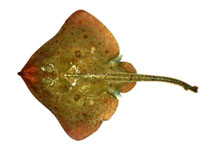
Lớp phụ Cá sụn (cá mập và cá đuối) (sharks and rays) >
Rajiformes (Skates and rays) >
Arhynchobatidae (Softnose skates)
Etymology: parmifera: Name from Latin 'parma' meaning shield, and 'fero' for 'to bear', likely in reference to the strong thorns along the midline. (Ref. 89865).
More on author: Bean.
Môi trường: môi trường / vùng khí hậu / Mức độ sâu / phạm vi phân phối
Sinh thái học
biển gần đáy; mức độ sâu 20 - 1450 m (Ref. 56527), usually 120 - 450 m (Ref. 56527). Boreal; 2°C - 7°C (Ref. 56527)
North Pacific: Bering Sea to southeastern Alaska.
Chiều dài lúc trưởng thành đầu tiên / Bộ gần gũi / Khối lượng (Trọng lượng) / Tuổi
Chín muồi sinh dục: Lm 90.5, range 81 - 95 cm
Max length : 135 cm TL con đực/không giới tính; (Ref. 85855); Khối lượng cực đại được công bố: 18.2 kg (Ref. 56527)
Mô tả ngắn gọn
Khóa để định loại | Hình thái học | Sinh trắc học
This species is distinguished from all other members of the subgenus Arctoraja by having a complete or, uncommonly, an incomplete row of dorsal thorns extending from the nuchal region to the interdorsal; dorsum nearly uniform brown, often with vague dark spotting and a yellowish blotch at pectoral-fin base; and two unique COI haplotypes. It is further distinguished from B. panthera by having fewer total thorns 19-36 (vs. 31-42), fewer tail thorns 15-23 (vs.19-28), internal carotid foramina widely separated (vs. foramina in a single
median pit), distal portion of ventral marginal cartilage distolaterally directed and straight (vs. sinusoidal), accessory terminal 2 broadly triangular with short spike (vs. elongate with long spike), distal tip of axial cartilage bluntly rounded (vs. pointed), anterior portion of body short and narrow (vs. longer and wider); tail short (vs. longer); from B. simoterus by its wider interdorsal space 1.0-3.9% TL (vs. 0.5-1.0% TL), fewer precaudal and caudal vertebrae 32-40 and 82-89 (vs. 41 and 90), fewer tail thorns 15-23 (vs. 22-28), larger orbit 4.3-5.3% TL (vs. 2.6-4.8% TL), anterior- and posterior-most postdorsal and postventral foramina of the scapulacoracoid larger than three intervening foramina (vs. three postdorsal foramina slightly smaller posteriorly, posteriormost postventral foramina four times larger than preceding
six foramina), distal projection of the ventral marginal directed distolaterally (vs. distally), ventral terminal tear-drop shaped (vs. lanceolate), and dorsal and ventral marginals extend to about a quarter the length of dorsal terminal 2 (vs. extending farther distally to distal tip of dorsal terminal 3); from B. smirnovi by its typically complete dorsal row of thorns (vs. always broadly interrupted between the nuchal and tail thorns), wider interdorsal space (1.0-3.9% TL (vs. 0.1-1.4% TL), distal projection of the ventral marginal projecting distolaterally (vs. distally), ventral terminal tear-drop shaped (vs. lanceolate), and dorsal and ventral marginals extending to about a quarter the length of dorsal terminal 2 (vs. extending farther distally to distal tip of dorsal terminal 3) (Ref. 89865).
Body shape (shape guide): other.
An epi- to mesobenthic species (Ref. 89865). Large individuals are reported to feed on Pleurogrammus monopterygius and miscellaneous other fishes, while the smaller ones feed on crabs and amphipods; in the eastern Bering Sea, mature individuals feed primarily on Theragra chalcogramma, miscellaneous fishes, and Chionocetescrabs (Ref. 89865). Oviparous. Distinct pairing with embrace. Young may tend to follow large objects, such as their mother (Ref. 205). Eggs are oblong capsules with stiff pointed horns at the corners deposited in sandy or muddy flats (Ref. 205). Egg capsules are 12.9-15.0 cm long and 8.9-9.1 cm wide (Ref. 41249, 41298).
Oviparous, paired eggs are laid. Embryos feed solely on yolk (Ref. 50449). Distinct pairing with embrace. Young may tend to follow large objects, such as their mother (Ref. 205). Eggs have horn-like projections on the shell (Ref. 205).
McEachran, J.D. and K.A. Dunn, 1998. Phylogenetic analysis of skates, a morphologically conservative clade of elasmobranchs (Chondrichthyes: Rajidae). Copeia 1998(2):271-290. (Ref. 27314)
Tình trạng Sách đỏ IUCN (Ref. 130435: Version 2025-2 (Global))
Mối đe dọa đối với con người
Harmless
Sử dụng của con người
Các nghề cá: bycatch
Các công cụ
Báo cáo đặc biệt
Tải xuống XML
Các nguồn internet
Ước tính dựa trên mô hình
Nhiệt độ ưa thích (Tài liệu tham khảo
123201): -0.5 - 5.8, mean 1.5 °C (based on 556 cells).
Chỉ số đa dạng phát sinh loài (Tài liệu tham khảo
82804): PD
50 = 0.6250 [Uniqueness, from 0.5 = low to 2.0 = high].
Bayesian length-weight: a=0.00417 (0.00340 - 0.00511), b=3.09 (3.03 - 3.15), in cm total length, based on LWR estimates for this species (Ref.
93245).
Mức dinh dưỡng (Tài liệu tham khảo
69278): 4.2 ±0.5 se; based on diet studies.
Generation time: 12.6 ( na - na) years. Estimated as median ln(3)/K based on 2
growth studies.
Thích nghi nhanh (Tài liệu tham khảo
120179): thấp, thời gian nhân đôi của chủng quần tối thiểu là 4.5 - 14 năm (Fec assumed to be <100).
Prior r = 0.12, 95% CL = 0.08 - 0.18, Based on 1 full stock assessment.
Sự dễ bị tổn thương của nghề đánh cá (Ref.
59153): High to very high vulnerability (69 of 100).
🛈