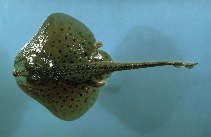
Elasmobranchii (tubarões e raias) (sharks and rays) >
Rajiformes (Skates and rays) >
Rajidae (Skates)
Etymology: Leucoraja: Greek, leykos = white + Latin, raja = a fish, Raja sp. (Ref. 45335).
More on author: Mitchill.
Ambiente: milieu / zona climática / intervalo de profundidade / gama de distribuição
Ecologia
marinhas demersal; oceanódromo (Ref. 51243); intervalo de profundidade 10 - 914 m (Ref. 106604). Temperate; 49°N - 33°N, 78°W - 59°W (Ref. 55277)
Western Atlantic: southern Gulf of St. Lawrence and Nova Scotia in Canada to North Carolina, USA.
Comprimento na primeira maturidade / Tamanho / Peso / Idade
Maturidade: Lm 37.5, range 32 - 43 cm
Max length : 62.0 cm TL macho/indeterminado; (Ref. 106604); Idade máx. registada: 12 anos (Ref. 88929)
Usually on sandy or gravelly bottoms from shoal waters to 90 m depth (Ref. 7251), with temperature range of 1.2-21°C. Benthic (Ref. 5951). Mostly inactive during daylight, but active under dark conditions (Ref. 10807). Feeds on bottom-dwelling organisms such as crabs, shrimps, polychaetes, sea squirts, mollusks, squids and bony fishes (Ref. 27549). Oviparous. Distinct pairing with embrace. Young may tend to follow large objects, such as their mother (Ref. 205). Eggs are oblong capsules with stiff pointed horns at the corners deposited in sandy or muddy flats (Ref. 205). Egg capsules are 4.6-6.3 cm long and 2.7-4.8 cm wide, about 10-35 eggs are laid annually (Ref. 41250). Possesses an electric organ located in the tail region (Ref. 10807). Electric organ discharge (EOD) activity is intermittent (Ref. 10011) and seemed more frequent during dark periods (Ref. 10808). The individual EOD of this species is monophasic, head-negative, and lasts 70 ms (Ref. 10011).
Oviparous, paired eggs are laid. Embryos feed solely on yolk (Ref. 50449). Distinct pairing with embrace. Young may tend to follow large objects, such as their mother (Ref. 205).
McEachran, J.D. and K.A. Dunn, 1998. Phylogenetic analysis of skates, a morphologically conservative clade of elasmobranchs (Chondrichthyes: Rajidae). Copeia 1998(2):271-290. (Ref. 27314)
Categoria na Lista Vermelha da IUCN (Ref. 130435: Version 2025-2 (Global))
Ameaça para o homem
Harmless
Utilização humana
Pescarias: pouco comercial
Ferramentas
Relatórios especiais
Descarregue XML
Fontes da internet
Estimativas baseadas em modelos
Temperatura preferida (Ref.
123201): 3.3 - 11.9, mean 6.8 °C (based on 97 cells).
Índice de diversidade filogenética (Ref.
82804): PD
50 = 0.5000 [Uniqueness, from 0.5 = low to 2.0 = high].
Bayesian length-weight: a=0.00282 (0.00249 - 0.00320), b=3.22 (3.19 - 3.25), in cm total length, based on LWR estimates for this species (Ref.
93245).
Nível Trófico (Ref.
69278): 3.6 ±0.1 se; based on diet studies.
Resiliência (Ref.
120179): Baixo, tempo mínimo de duplicação da população 4,5 - 14 anos (K=0.29-0.35; tm=4.5; Fec=10; tmax=12).
Prior r = 0.09, 95% CL = 0.06 - 0.14, Based on 1 full stock assessment.
Vulnerabilidade da pesca (Ref.
59153): Moderate to high vulnerability (50 of 100).
🛈
Vulnerabilidade climática (Ref.
125649): Very high vulnerability (90 of 100).
🛈
Nutrientes (Ref.
124155): Calcium = 8.66 [1.21, 152.16] mg/100g; Iron = 0.286 [0.027, 3.412] mg/100g; Protein = 15.9 [13.9, 17.9] %; Omega3 = 0.79 [0.34, 1.99] g/100g; Selenium = 11.9 [2.5, 63.8] μg/100g; VitaminA = 6.64 [0.51, 72.57] μg/100g; Zinc = 0.394 [0.028, 4.300] mg/100g (wet weight);