Rypticus bicolor, Mottled soapfish : fisheries

You can sponsor this page

Rypticus bicolor Valenciennes, 1846

Mottled soapfish
Aggiungete la vostra osservazione in Fish Watcher
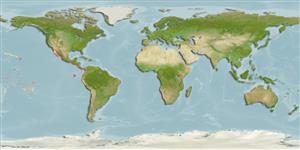
Native range
This map was computer-generated and has not yet been reviewed.
Rypticus bicolor   AquaMaps   Data sources: GBIF OBIS
Carica il tuo foto e Video
Immagini | Video | Google image
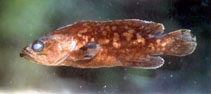
Image of Rypticus bicolor (Mottled soapfish)
Rypticus bicolor
Immagine di Guimarães, R. Z. P.

Classificazione / Nomi Nomi Comuni | Sinonimi | Catalog of Fishes(Genere, Specie) | ITIS | CoL | WoRMS | Cloffa

> Perciformes/Serranoidei (Groupers) > Grammistidae (Soapfishes)
Etymology: Rypticus: Greek, ryptikos, -e, -on = easy to wash (Ref. 45335).
More on author: Valenciennes.

Ambiente: milieu / zona climatica / distribuzione batimetrica / gamma di distribuzione Ecologia

marino demersale; distribuzione batimetrica 3 - 68 m (Ref. 5227). Tropical

Distribuzione Territories | Aree FAO | Ecosistemi | Presenze | Mappa dei ritrovamenti | Introduzioni | Faunafri

Eastern Pacific: Baja California to Peru, including the Galapagos and other offshore islands.

Dimensione / Peso / Età

Maturità: Lm ?  range ? - ? cm
Max length : 28.0 cm TL maschio/sesso non determinato; (Ref. 5227)

Breve descrizione Chiavi di identificazione | Morfologia | Morfometria

Spine dorsali (totale) : 3; Raggi dorsali molli (totale) : 23 - 26; Raggi anali molli: 16 - 18; Vertebre: 24. Sides of body, excluding cheeks, mottled with cream to pale-brown blotches on dark background, reaching onto bases of median fins; blotches are poorly-defined and often coalescing. Body and head, excluding lips and maxillary, with embedded scales. Dorsal spines 3 (rarely 2). Lower jaw projecting, with prominent fleshy protuberance. Numerous, small pores, in patches, along ventral surface of lower jaw and on the free-edge of preopercle in > 6.5 cm SL specimens (Ref. 40934).
Body shape (shape guide): short and / or deep; Cross section: compressed.

Biologia     Glossario (es. epibenthic)

Lives in rocky reefs, sheltering in caves and crevices but also encountered in the open (Ref. 11482). Lies motionless, often on its side, hidden in dark recesses. Actively hunts at night, preying on small fish (Ref. 5227).

Ciclo vitale e comportamento di accoppiamento Maturità | Riproduzione | Deposizione | Uova | Fecondità | Larve

Riferimento principale Caricare le referenze | Bibliografia | Coordinatore | Collaboratori

Allen, G.R. and D.R. Robertson, 1994. Fishes of the tropical eastern Pacific. University of Hawaii Press, Honolulu. 332 p. (Ref. 11482)

Stato della Lista Rossa IUCN (Ref. 130435: Version 2025-2 (Global))

  Least Concern (LC) ; Date assessed: 01 May 2008

CITES

Not Evaluated

CMS (Ref. 116361)

Not Evaluated

Minaccia per l'uomo

  Harmless


Usi umani

Pesca: commerciale
FAO - Publication: search | FishSource |

Informazioni ulteriori

Ecologia trofica
Articoli alimentari (prede)
Alimentazione
Consumo di cibo
Razioni alimentari
Predatori
Ecologia
Ecologia
Dinamica della popolazione
Parametri di crescita
Età massima / dimensioni massime
Rapporto lunghezza-peso.
Lunghezza-lunghezza rel.
Lunghezza-frequenze
Conversione di massa
Reclutamento
Abbondanza
Ciclo di vita
Riproduzione
Maturità
Maturità/Gli occhielli sono relativi.
Fecondità
Deposizione
Aggregazioni riproduttive
Uova
Sviluppo delle uova
Larve
Dinamica popolazioni larvali
Distribuzione
Territories
Aree FAO
Ecosistemi
Presenze
Introduzioni
BRUVS - Video
Anatomia
Area branchiale
Cervello
Otolite
Fisiologia
Composizione corporea
Nutrienti
Consumo di ossigeno
Tipo di nuoto
Velocità di nuoto
Pigmenti visivi
Suono del pesce
Malattie e parassiti
Tossicità (LC50)
Genetica
Genome
Genetica
Eterozigosi
Ereditarietà
Diversità genetica
Legato all'uomo
Sistemi di acquacoltura
Profili di acquacoltura
Varietà
Casi di Ciguatera
Francobolli, monete, materiale vario.
Raggiungimento
Collaboratori
Bibliografia
Bibliografia

Strumenti

Rapporti speciali

Scarica XML

Fonti Internet

AFORO (otoliths) | Aquatic Commons | BHL | Cloffa | Websites from users | Check FishWatcher | CISTI | Catalog of Fishes: Genere, Specie | DiscoverLife | ECOTOX | FAO - Publication: search | Faunafri | Fishipedia | Fishtrace | GloBI | Google Books | Google Scholar | Google | IGFA World Record | OneZoom | Open Tree of Life | Otolith Atlas of Taiwan Fishes | PubMed | Reef Life Survey | Socotra Atlas | TreeBase | Tree of Life | Wikipedia: Go, ricerca | World Records Freshwater Fishing | Zoobank | Record zoologico

Stime basate su modelli

Temperatura preferita (Fonte Biblio. 123201): 20.6 - 28.9, mean 25.9 °C (based on 82 cells).
Indice di diversità filogenetica (Fonte Biblio. 82804):  PD50 = 0.5005   [Uniqueness, from 0.5 = low to 2.0 = high].
Bayesian length-weight: a=0.01738 (0.00662 - 0.04565), b=3.01 (2.78 - 3.24), in cm total length, based on LWR estimates for this (Sub)family-body shape (Ref. 93245).
Livello trofico (Fonte Biblio. 69278):  4.0   ±0.7 se; based on size and trophs of closest relatives
Vulnerabilità della pesca (Ref. 59153):  Low vulnerability (18 of 100). 🛈
Categoria di prezzo (Ref. 80766):   Very high.
Nutrienti (Ref. 124155):  Calcium = 44.6 [25.1, 94.7] mg/100g; Iron = 0.517 [0.281, 0.958] mg/100g; Protein = 18.2 [16.3, 19.9] %; Omega3 = 0.131 [0.078, 0.212] g/100g; Selenium = 32.1 [18.1, 62.3] μg/100g; VitaminA = 78.8 [20.8, 340.7] μg/100g; Zinc = 0.966 [0.632, 1.471] mg/100g (wet weight);