Ikan bertulang rawan (sharks and rays) >
Torpediniformes (Electric rays) >
Narcinidae (Numbfishes)
Etymology: Narcine: Greek, narke = numbness (Ref. 45335).
Lingkungan: lingkungan / zona iklim / kisaran kedalaman / jangkauan distribusi
Ekologi
laut berasosiasi dengan karang; kisaran kedalaman 1 - 43 m (Ref. 13608). Subtropical; 37°N - 39°S, 98°W - 34°W
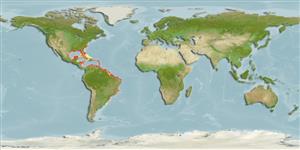
Western Atlantic: Espirito Santo, Brazil to northern Argentina (Carvalho, pers. comm.). North Carolina, USA to Florida, northern Gulf of Mexico, central Lesser Antilles and Yucatan (Ref. 26938).
Panjang pada saat jatuh tempo pertama / Ukuran / Berat / umur
Kematangan: Lm 28.8 range ? - ? cm
Max length : 54.0 cm WD jantan/; (Ref. 26340); common length : 35.0 cm WD jantan/; (Ref. 5217); Berat maksimum terpublikasi: 650.00 g (Ref. 6902)
deskripsi pendek
Kunci identifiaksi (pengenalan) | Morfologi | Morfometrik
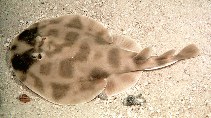
A pale sand-colored ray, often with ellipses of dark spots on dorsal side of rounded disk (Ref. 26938). Grayish to reddish brown, many rounded blotches outlined with blackish spots. Dark bands across tail up to dorsal fin. Snout darkened (Ref. 7251).
Body shape (shape guide): other.
Inhabits coastal waters, on sand or mud bottoms (Ref. 26340). Common along sandy shorelines, sometimes near coral reefs (Ref. 12951). Aggregates in shallow waters ca. 10-20 m deep during summer and autumn months, dispersing to deeper waters during winter (Ref. 114953). Buries itself with only eyes protruding (Ref. 12951). Nocturnal, moves to shallow bays at night to feed; prefers worms, but may take juvenile snake eels, anemones, and, small crustaceans (Ref. 12951). Produces broods of 4 to 15 young (Ref. 26938). Reaches ca. 45 cm TL. Both sexes mature by 27 cm TL; birth size at ca. 11 cm TL (Ref. 114953). Can discharge between 14 and 37 volts. Contact with the skin can produce a severe electric shock. In addition to the main electric organ, this species possesses a bilateral accessory electric organ (Ref. 10011) speculated to have a possible role in social communication (Ref. 10489). Reported to taste good, but not fished commercially. Traded as an aquarium fish at Ceará, Brazil (Ref. 49392).
Siklus hidup dan perilaku kawin
Kematangan | Reproduksi, perkembang biakan | Pemijahan | telur-telur | Fekunditas | Larva
Ovoviviparous. Sex ratio of embryos is about one to one, however, small mothers may have predominantly female embryos and that for a given mother, embryos tend to be of one sex (Ref. 46979). Maximum number of embryos per female may reach 15. The young are capable of giving off electric charges even before they are released from the womb (Ref. 46978).
Robins, C.R. and G.C. Ray, 1986. A field guide to Atlantic coast fishes of North America. Houghton Mifflin Company, Boston, U.S.A. 354 p. (Ref. 7251)
Status IUCN Red List (Ref. 130435: Version 2025-2 (Global))
penggunaan manusia
Perikanan: perikanan swasembada; Akuarium: Komersial
Alat, peralatan
laporan khas
muat turun XML
Sumber internet
Estimasi berdasarkan model
Suhu yang disukai (Acuan
123201): 22.9 - 28, mean 25.6 °C (based on 442 cells).
Indeks keanekaragaman filogenetik (Acuan
82804): PD
50 = 0.5000 [Uniqueness, from 0.5 = low to 2.0 = high].
Bayesian length-weight: a=0.01122 (0.00605 - 0.02082), b=2.90 (2.73 - 3.07), in cm total length, based on LWR estimates for this species & (Sub)family-body (Ref.
93245).
Tingkat Trofik (Acuan
69278): 3.2 ±0.4 se; based on diet studies.
Daya lenting (Acuan
120179): Rendah, Waktu penggandaan populasi minimum 4.5 - 14 tahun (Assuming fecundity<100).
Kerentanan Penangkapan Ikan (Ref.
59153): Low to moderate vulnerability (34 of 100).
🛈
Nutrisi (Ref.
124155): Calcium = 6.47 [0.67, 106.25] mg/100g; Iron = 0.472 [0.039, 5.319] mg/100g; Protein = 16.6 [12.4, 21.0] %; Omega3 = 0.145 [0.049, 0.421] g/100g; Selenium = 14.3 [2.3, 70.5] μg/100g; VitaminA = 22.2 [1.8, 283.1] μg/100g; Zinc = 0.82 [0.06, 9.22] mg/100g (wet weight);