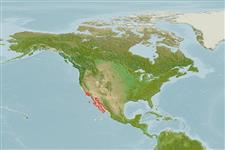
Lingkungan: lingkungan / zona iklim / kisaran kedalaman / jangkauan distribusi
Ekologi
laut; payau dasar (demersal); kisaran kedalaman 1 - 91 m (Ref. 48844), usually 1 - 13 m (Ref. 48844). Tropical; 38°N - 18°N, 123°W - 106°W (Ref. 114953)
Eastern Pacific: endemic to the eastern Pacific from San Francisco, USA to the Gulf of California, and possibly to Mazatlan, Mexico (Ref. 48844).
Panjang pada saat jatuh tempo pertama / Ukuran / Berat / umur
Kematangan: Lm ?, range 57 - ? cm
Max length : 119 cm TL jantan/; (Ref. 48844); 170.0 cm TL (female); Berat maksimum terpublikasi: 9.8 kg (Ref. 40637); Berat maksimum terpublikasi: 9.8 kg; Umur maksimum dilaporkan: 16 Tahun (Ref. 48844)
deskripsi pendek
Kunci identifiaksi (pengenalan) | Morfologi | Morfometrik
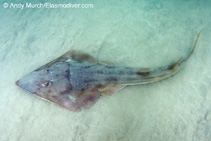
Broad disc is greater in length than width; a relatively smooth dorsal surface except for a single row of thorns around the eyes and extending along the back and tail; a long, pointed snout with a rounded tip; small, rounded, pebble-like teeth; a first dorsal fin that originates closer to the pelvic fin base than to the caudal fin origin; a thick tail and a moderately large caudal fin without a distinct lower lobe. Tooth count: 102-112/98-117. Spiral valve count: 8-10.
Body shape (shape guide): elongated.
Found on sand or mud bottoms of bays, seagrass beds, estuaries, and near rocky reefs. Nomadic and gregarious. Found singly or in aggregations (Ref. 12951). Burrows in sand during the day, feeds on crabs, worms, clams and small fishes at night (Ref. 12951). Ovoviviparous, with 6 to 28 pups in a litter (Ref. 48844). Females mature by 7 years at 87-99 cm TL; males reaches 91-110 cm TL; birth size at 20-24 cm TL (Ref. 114953).
Etymology: The genus comes from the Greek word rhine, meaning shark, and the Latin word batis, meaning ray, in reference to its body form being intermediate between that of a shark and a ray. The species name comes Latin, meaning produced, in reference to its pointed snout (Ref. 48844).
Exhibit ovoviparity (aplacental viviparity), with embryos feeding initially on yolk, then receiving additional nourishment from the mother by indirect absorption of uterine fluid enriched with mucus, fat or protein through specialised structures (Ref. 50449).
Adults of both sexes congregate during the breeding season in shallow bays and estuaries and likewise leave when the pupping season is over after mating (Ref. 48844). Gestation lasts for about 12 months (Ref. 48844).
Eschmeyer, W.N., E.S. Herald and H. Hammann, 1983. A field guide to Pacific coast fishes of North America. Boston (MA, USA): Houghton Mifflin Company. xii+336 p. (Ref. 2850)
Status IUCN Red List (Ref. 130435: Version 2025-2 (Global))
penggunaan manusia
Perikanan: komersial; Ikan buruan: ya
Alat, peralatan
laporan khas
muat turun XML
Sumber internet
Estimasi berdasarkan model
Suhu yang disukai (Acuan
123201): 15.3 - 25.9, mean 22.4 °C (based on 149 cells).
Indeks keanekaragaman filogenetik (Acuan
82804): PD
50 = 0.5020 [Uniqueness, from 0.5 = low to 2.0 = high].
Bayesian length-weight: a=0.00209 (0.00136 - 0.00320), b=3.10 (2.97 - 3.23), in cm total length, based on LWR estimates for this species & Genus-body shape (Ref.
93245).
Tingkat Trofik (Acuan
69278): 3.6 ±0.3 se; based on diet studies.
Generation time: 11.0 ( na - na) years. Estimated as median ln(3)/K based on 2
growth studies.
Daya lenting (Acuan
120179): Rendah, Waktu penggandaan populasi minimum 4.5 - 14 tahun (tm=7; tmax=11; K=0.1; Fec = 6).
Kerentanan Penangkapan Ikan (Ref.
59153): High vulnerability (65 of 100).
🛈
Nutrisi (Ref.
124155): Calcium = 32.6 [8.1, 140.3] mg/100g; Iron = 0.666 [0.163, 1.807] mg/100g; Protein = 18.8 [16.7, 20.7] %; Omega3 = 0.146 [0.065, 0.333] g/100g; Selenium = 50.9 [14.7, 138.9] μg/100g; VitaminA = 12.1 [5.5, 26.8] μg/100g; Zinc = 1.03 [0.51, 1.86] mg/100g (wet weight);